A clinician’s vibe-coded prototype can’t legally hold patient data. The tool writes the code; the backend that holds that data, with a signed BAA and an audit trail behind it, is yours to build.
The key points:
- Of the six tools compared, only Cursor and Claude Code offer a BAA, each on its top tier under conditions. Replit, Base44 and Lovable bar PHI outright.
- Veracode found 45% of AI-generated code ships with an OWASP Top 10 flaw. In a health app, that is a reportable HIPAA breach.
- A prototype can clear security and compliance and still return the wrong clinical answer. That check stays with the clinician.
- Healthcare resources (SpeziVibe, AIM4Med, Physician Builders, MedPromptHub) help you plan and prototype. None takes you to production.
- MEV took Anova’s ClinicalDenialPro from a Base44 prototype to a HIPAA-grade AWS system with zero record loss. The article turns that rebuild into a six-step sequence for your own app.
The pattern: vibe code to prove the idea, then harden it before it handles patient data.
A clinician can describe a patient intake app to an AI tool and have a working version the same afternoon. That version has no signed business associate agreement (BAA) behind it, and it lets any logged-in user open any patient's record. It cannot legally hold patient data.
This is vibe coding: you prompt an AI in plain language and it writes the code. Reaching a working prototype is quick. A HIPAA-compliant app needs the backend the tool skips, plus the safeguards you add yourself.
This article compares the main vibe coding tools on healthcare fit, covers the healthcare-specific tools and resources built around them, and shows what it takes to get a vibe-coded app to production that can legally hold patient data.
Can You Build a HIPAA-Compliant App by Vibe Coding?
Not with the tool by itself. HIPAA compliance comes from the backend that holds protected health information (PHI) and the safeguards around it. Most vibe coding tools ship neither by default.
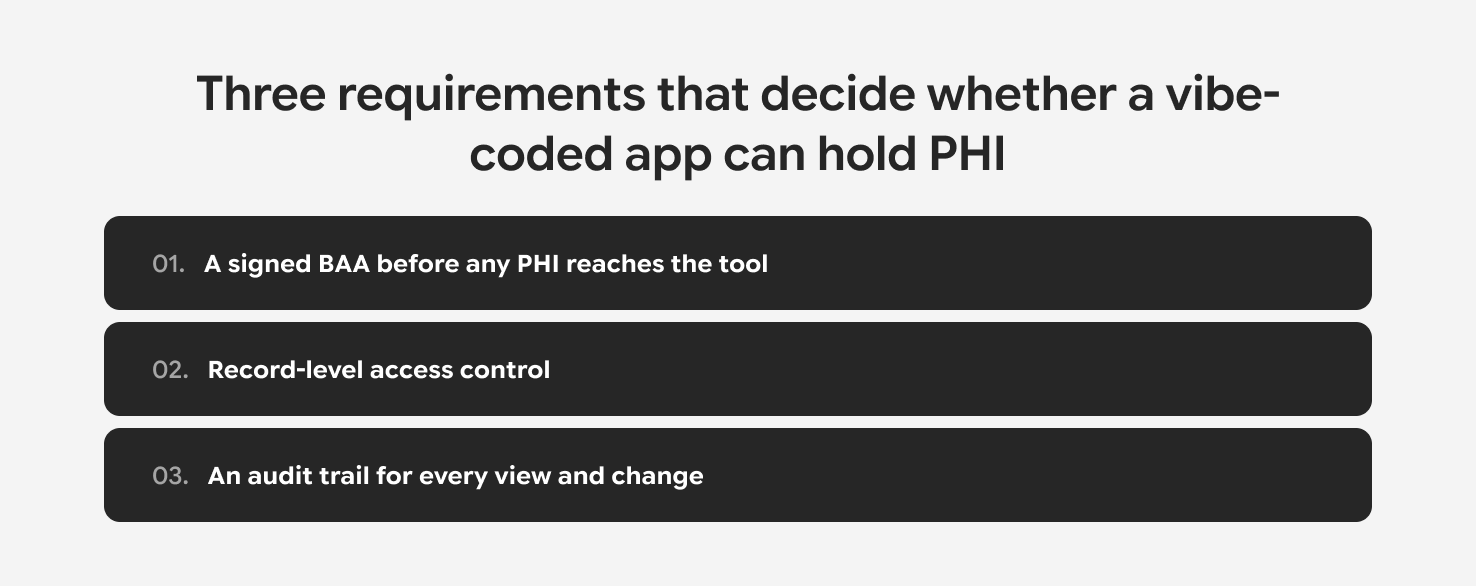
Three HIPAA Security Rule requirements decide whether a vibe-coded app can hold PHI.
1. A signed BAA before any PHI reaches the tool. HIPAA requires a business associate agreement with every vendor that creates, receives, maintains, or transmits PHI (45 CFR 164.308(b)(1)). Most vibe coding tools do not include one in their standard plans.
A missing BAA is a violation on its own. OCR fined Raleigh Orthopaedic Clinic $750,000 after it handed the PHI of 17,300 patients to a potential business partner with no agreement in place.
2. Record-level access control. The Security Rule limits access to authorized users and software (45 CFR 164.312(a)(1)). A vibe-coded app often checks that you are logged in but never checks which records you are allowed to see. A front desk user can open a clinician's notes.
3. An audit trail for every view and change. Audit controls (45 CFR 164.312(b)) require systems to record and examine access to PHI. Generated backends rarely produce a log you could hand to an investigator.
AI tools add a failure mode of their own. PHI a clinician pastes into a prompt during debugging can land in model logs or training data, outside your control before the app ever ships.
How much of this you need depends on what the app does. A self-service FAQ widget and a tool that reads clinical notes carry very different risks, and only the second needs the full weight of the Security Rule. A 2026 governance framework for clinical vibe coding, VIBE-HI, sorts clinical vibe coding by risk level on exactly this basis.
The more you let the AI build without checking what it produced, the more hardening a PHI-handling app needs before it reaches production.
How Do the Main Vibe Coding Tools Compare for Healthcare?
None of these tools is HIPAA-compliant on its own. Cursor and Claude Code offer a BAA on their top tier under conditions. Cline inherits coverage from the model backend you connect. Replit, Base44, and Lovable offer no BAA and bar PHI from the platform.
Vendor terms verified against each provider's own documentation as of October 2026. HIPAA posture changes often, so confirm current terms with the vendor before relying on this for a live deployment.
What Vibe Coding Tools and Resources Exist for Healthcare?
A few exist, though each covers only part of the job. No single tool yet takes a clinician from a vibe-coded healthcare app to HIPAA-ready production. Around the general build tools sits a support layer: Stanford offers a planning skill set, Physician Builders a platform for clinicians, AIM4Med a clinician course, and MedPromptHub a prompt library. Each helps with one part a general build tool skips, and none removes the production work.
SpeziVibe is a free, open-source set of installable planning skills from Stanford Biodesign Digital Health that you add to an AI coding agent like Claude Code or Cursor.
It walks you through the parts most builders skip, like compliance planning and health-data modeling, then sequences the build and offers starter templates for React Native, Apple-native, or your own framework. Your coding agent still writes the code, and hosting and compliance stay with you.
Physician Builders is a platform that lets clinicians author their own healthcare tools without an engineering team. Mike Logan, MD, the emergency medicine physician who founded it, explains what sets it apart:
Physician Builders is where clinicians design and pressure-test the idea. Turning what they build into a compliant, production-hosted system is still a separate step.
Vibe Coding for Clinicians is a free, ten-module course from AIM4Med, created by Amos Grünebaum, MD. It teaches clinicians to build their own clinical tools by directing AI, with no coding, covering the toolbox, the privacy and FDA lines, and a working tool you build and publish.
It teaches the skill and gets you a prototype. Making that prototype compliant and production-ready is separate work, which the course itself tells clinicians to hand to a developer once a tool serves many people or holds patient data.
MedPromptHub is a library of physician-designed prompt recipes for HIPAA-compliant LLMs, covering clinical workflows and documentation. It saves a clinician from writing prompts for common tasks from scratch. A prompt is only as compliant as the model behind it, so the library does nothing about PHI unless you run it on a BAA-covered LLM, and its diagnosis-support prompts still need a clinician's sign-off.
Put together, this layer helps you plan and prototype for healthcare. The hardest part stays with you: taking a prototype to production that can legally hold patient data. That is the step the next section covers.
What Breaks When a Vibe-Coded Health App Goes to Production?
The security of the code the AI wrote, and the compliance layer a healthcare app needs. Both stay invisible while the app is a prototype and surface the moment it carries patient data at scale.
Veracode's 2025 GenAI Code Security Report ran 80 security-sensitive tasks across more than 100 models and found that 45% of AI-generated code shipped with a flaw from the OWASP Top 10, the Open Web Application Security Project's list of the most critical web application security risks.
Veracode's CTO, Jens Wessling, named vibe coding as the shift behind the risk, where "developers rely on AI to generate code, typically without explicitly defining security requirements." Larger models did not lower the flaw rate, and Veracode calls the problem systemic.
A flaw that is a routine bug in most apps exposes PHI in a health app. Under HIPAA, that makes it a reportable breach. At production scale, those compliance gaps become openings an auditor or an attacker will find. Hosting with no BAA, access that stops at the login: each is an item on the HIPAA production-readiness checklist.
The third exposure sits in the clinical logic, and it survives everything above. A tool can clear security and compliance and still return the wrong answer. Amos Grünebaum, MD, who teaches the AIM4Med course, put it to us directly:
The hardening below closes the security and compliance gaps. This last check stays with the clinician.
What does hardening a vibe-coded healthcare app look like?
Hardening means rebuilding the backend a prototype skipped: the data layer, the access controls, and the hosting that can legally hold patient data. Anova Medical Associates is a case of what that takes.
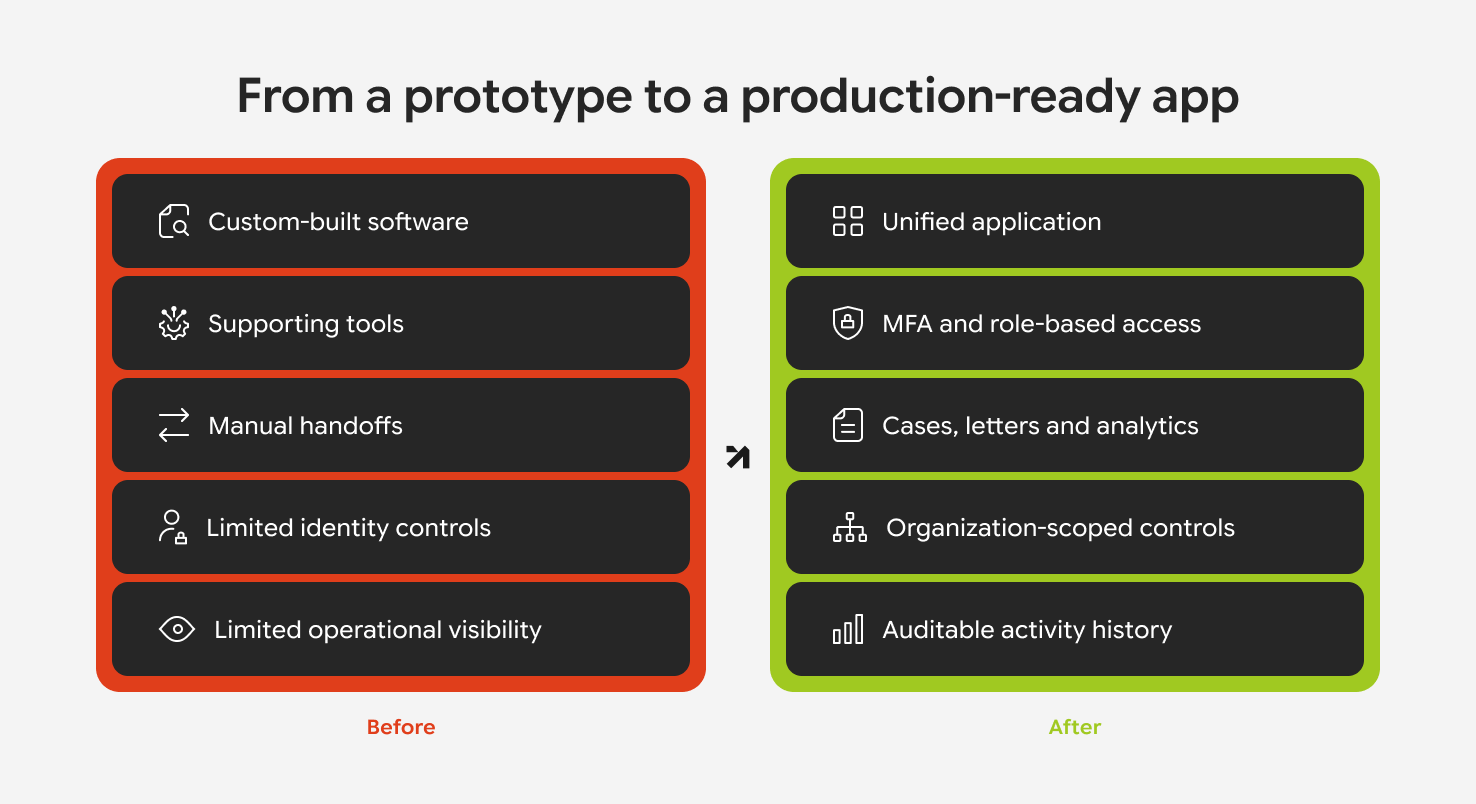
A physician at Anova Medical Associates, a group that runs denial and utilization reviews for hospitals, built a denial-review app called ClinicalDenialPro in Base44. The prototype worked and case preparation dropped from about 30 minutes to 5. When Anova wanted to extend it across more users and hospitals, the prototype needed the foundation that multi-site healthcare software requires.
We audited the existing app to set the baseline for the rebuild. The biggest change was access control: we moved it out of the browser and into the backend, scoped to each hospital and behind mandatory multi-factor authentication.
Patient data got its own protected path. We routed the model through Amazon Bedrock and the dictation through Amazon Transcribe, so no sensitive data travels through an uncontrolled channel. Storage became encrypted and recoverable, every patient-record access is now logged, and the Base44 SDK is out of production entirely. The migration reconciled every record with zero loss.
How to take a vibe-coded healthcare app to production
To take a vibe-coded healthcare app to production, keep patient data out until the backend is rebuilt to hold it safely, then harden the prototype step by step. A healthcare data breach is the costliest of any industry, at $6.64 million per incident in IBM's 2026 Cost of a Data Breach Report, and the sequence below is what prevents one.

The Anova rebuild followed this sequence. Here it is as steps for your own app.
- Keep PHI out until the foundation is ready. Build and test with synthetic data. A prototype has no BAA behind it, so any patient data that goes in is an exposure from the first click.
- Separate what to keep from what to rebuild. Keep the workflow and the prompts that already work. Rebuild what sits underneath: the data layer and the hosting a prototype never set up for production.
- Audit the prototype before you change anything. Map where patient data moves and whether a recoverable backup exists. This is where most of the risk hides, and it gives every later step its targets.
- Move access control from the browser to the backend. The prototype trusts the browser to decide what a user sees. Production enforces it server-side, scoped so no one can reach another patient's record.
- Route every AI and data path through covered infrastructure. If the app sends patient data to a model, route it through BAA-covered services such as a cloud provider's healthcare offerings, and keep patient identifiers out of prompts where the workflow allows.
- Add the controls that make it auditable and recoverable. Encrypted storage, a log of who accessed which record, restorable backups, and security checks on every change.
The pattern underneath: vibe code to prove the idea, then harden it before it handles live patient data.
Where to Go from a Working Prototype
Making the vibe-coded healthcare app safe for patients is a separate engineering project: a signed BAA, record-level access control, an audit trail, and a backend built to hold PHI. The tool that generated the prototype supplies none of that, and skipping it turns a routine code flaw into a reportable breach the moment patient data is in the system.
That is the step MEV handles. We took Anova's prototype to a HIPAA-grade system on AWS with zero record loss, keeping the physician's workflow intact while rebuilding everything underneath it.
If you have a vibe-coded healthcare app that needs to hold patient data, MEV's vibe-code-to-production service is built for exactly that step.
We wrote this for anyone building a healthcare app by vibe coding and wondering if it can legally hold patient data. Every tool's HIPAA posture was checked against the vendor's own documentation, current as of October 2026, because these terms change: Cursor now signs a HIPAA BAA on its enterprise plan, though many comparison articles still say it signs none.
For the healthcare-specific resources, SpeziVibe, AIM4Med, Physician Builders, and MedPromptHub, we checked each against its own source and went to the people behind Physician Builders and AIM4Med for first-hand input.
The production steps come from our own work: rebuilding Anova's ClinicalDenialPro from a Base44 prototype into a HIPAA-grade AWS system.