AI builders like Replit get a vibe-coded app 70 to 80% of the way; the missing 20 to 30% is the part that survives real users without dropping logins or double-charging cards, and that's the work these agencies do.
Evaluate any vibe-code-to-production partner on six capabilities: codebase stabilization and security, deployment and hosting migration, data and auth migration, AI integration and cost control, observability and recovery, and handoff and maintainability.
Each capability maps to a real risk (security, uptime, login control, data separation, observability, payments), so use the six as the questions you ask anyone you shortlist.
The five agencies covered: MEV, Slashdev.io, Red Leg Dev, Pragmatic Coders, and Razoyo.
You vibe coded a Replit MVP or another AI-built app, and it got you further than you expected. Now your first users are on it, and three decisions follow. Do you migrate off Replit? How do you harden a prototype built only for demos? And who do you trust to do it? AI builders get you 70 to 80% there. The missing 20-30% is the part that survives a traffic spike without dropping logins or double-charging cards. This guide ranks the partners who specialize in vibe coding to production and helps you evaluate and choose the right one.
How Do You Evaluate a Vibe Coding to Production Partner?
You evaluate a vibe-code-to-production partner on six capabilities, one for each risk your app faces once real users arrive. Before you shortlist anyone, get clear on what's at risk: security, uptime, login control, data separation, observability, and payments.
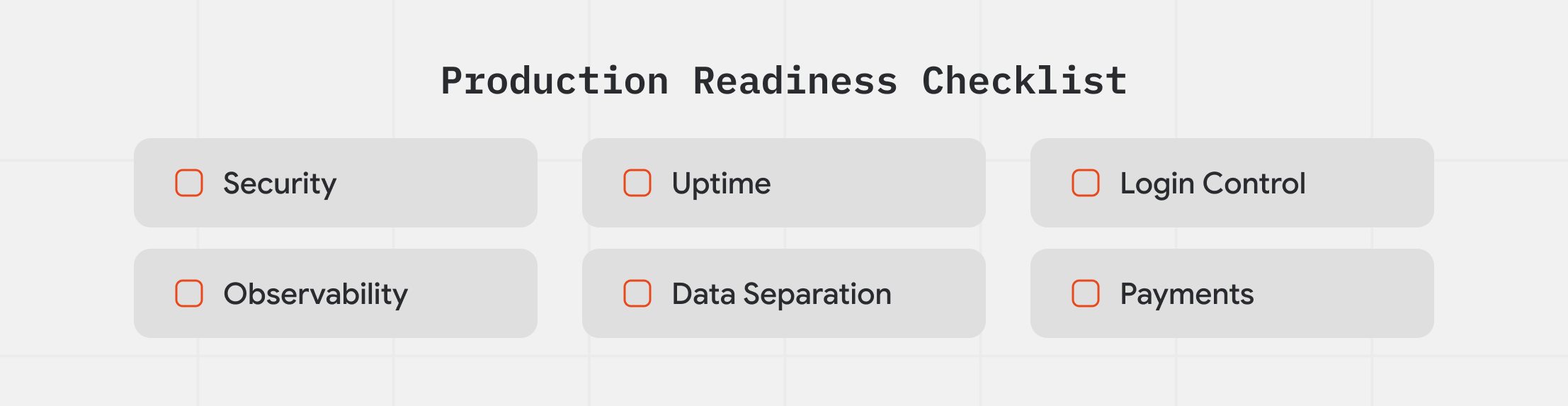
Each risk maps to a capability a production partner should cover. The six criteria below are those capabilities. Use them as the questions to ask anyone you are considering.
1. Codebase stabilization and security
Can they audit the code for vulnerabilities, clean up dependency hygiene, and address the OWASP Top 10 risks, with broken access control sitting at number one since 2021?
This is the highest-stakes area. Veracode's 2025 GenAI Code Security Report found AI introduced a security flaw in 45% of coding tasks tested.
Vibe coding tools’ main goal is a working demo, the security gaps aren’t their primary concern.
2. Deployment and hosting migration
Have they moved apps off Replit and onto infrastructure you control, such as Vercel, AWS, Supabase, Railway, or Render? The baseline is code that lives in your own Git repository and runs on a custom domain. No platform lock-in.
3. Data and auth migration
Can they separate your database and segregate your environments? And can they integrate Stripe so test and live data never touch? This is the work that protects your users and your revenue.
4. AI integration and cost control
If your app calls an LLM, can they cap what it spends with rate limits and usage ceilings, so a viral week does not become a five-figure bill?
Can they add retrieval-augmented generation (RAG) where it belongs and integrate the major providers like Claude and OpenAI, including tooling such as MCP (Model Context Protocol, the standard for connecting apps to LLMs)?
5. Observability and recovery
Do they install monitoring and alerts, and set clear targets for uptime and response? And do they give you a rollback path when something breaks?
6. Handoff and maintainability
Confirm this early, it's a basic one. When the work ends, do you own the code, the documentation, the tests, and access to every account? Even though it rarely comes up as a problem, it's worth checking at the start so nothing stays locked with the firm.
Which Companies Take a Vibe-Coded App to Production?
The table below compares the five, and the profiles that follow go deeper on each.
We vetted five agencies and grouped them by what they specialize in, because the right choice depends on what you need.
Some are strategic partners built for long-term products and regulated data. Others are focused rescue shops that fix a deployed app fast. Both have their place. Match the firm to the stage you are in and your product’s current and future needs.
1. MEV
MEV is a US-based software engineering company with 20 years of experience building and modernizing software products. Its Vibe-Code to Production service helps founders turn apps built with Replit, Lovable, Bolt, and Base44 into secure, maintainable production software.
MEV assesses the existing code, fixes security and architectural issues, hardens integrations, and sets up production infrastructure. Where possible, the team preserves working functionality and lets founders continue developing features while engineers handle production readiness. For healthcare products, the company also has a dedicated offering for vibe-coded healthcare applications, including migration to full-stack environments with HIPAA-aligned safeguards, secure patient data access, and audit logging.
Best for: Complex or regulated applications involving sensitive data, AI integrations, or demanding security requirements.
Key strengths:
- 97% of engineers are senior or mid-level, with experience in complex and regulated systems.
- Flexible productionization, from selective code hardening to complete backend rebuilding.
- Parallel development approach that allows founders to keep building while MEV prepares the application for production.
Limitations: MEV is better suited to projects requiring substantial production engineering than isolated bug fixes or quick patches.
Proof: MEV stabilized a Replit-built AI learning platform without a full rewrite and hardened 12 third-party integrations. For Anova Medical Associates, MEV migrated a physician-built Base44 healthcare application to AWS, adding backend-enforced access controls, MFA, audit logging, and secure AI processing.
2. Slashdev.io
Slashdev embeds senior engineers into your project and works like a fractional CTO (part-time senior tech leader). Every engineer is trained specifically in Claude Code and agentic development, which is how a small team ships production code fast.
Best for: Founders who need senior engineers and agentic-development expertise to harden and ship an already deployed app fast.
Key strengths:
- Scaled an e-commerce store to 10K+ daily users under $1K per month in infrastructure costs
- Focus on Claude Code and agentic workflows
- Senior engineers with 15+ years shipping at scale
Limitations: The company is audit and advisory first. If your Replit code needs new features built while it's being hardened, you'll need a second team.
Proof: Their Next.js store case study tracks the full move to 10K+ daily users.
3. Red Leg Dev
Red Leg Dev is a software studio run by one senior engineer who fixes AI-built apps that fail once people start using them. You work directly with the person writing the code.
Best for: Founders who want a quick fix without an agency around it.
Core strengths:
- One senior engineer with 15+ years in SaaS
- Works with apps from Cursor, Lovable, Bolt, v0, and Replit
- Flat $1,500 audit with a two-week turnaround
Limitations: For a large or urgent job that needs several people at once, a staffed development agency will have more capacity.
Proof: Client reviews highlight the owner's understanding of business needs and ability to handle complex CRM integrations.
4. Pragmatic Coders
Pragmatic Coders is an agency with a dedicated Vibe Coding Rescue service for founders whose AI-built app stalled on the way to production. They focus the work on the parts that matter for growth and user trust, then harden the code so it scales.
Best for: Funded founders who want a full agency team for an AI-coded rescue plus continued product work.
Core strengths:
- Building software since 2014, 150+ products shipped
- Full team across development, design, DevOps, and product
- Deep FinTech and HealthTech experience, useful for regulated data
Limitations: As a full-size agency, Pragmatic Coders is built for funded products rather than quick patches.
Proof: Project rescues make up roughly 30% of their work, and their client list runs from Atom Bank to crypto platform Common Wealth, which drew 63,000 users in three weeks.
5. Razoyo
Razoyo is a Dallas-Fort Worth software engineering firm that has been taking prototypes, vibe-coded applications, and inherited codebases into production for US companies since 2011. The team assesses existing software, identifies what needs fixing or rebuilding, and helps prepare applications for real users.
Best for: US companies with an existing prototype or codebase that needs production hardening or rebuilding.
Core strengths:
- Experience rebuilding inherited systems and improving scalability.
- Fixed-price Production Spec ($2,500) covering technical risks, remediation recommendations, and a build estimate.
- Ongoing engineering and maintenance after launch.
Limitations: No dedicated Replit or Bolt-specific package.
Proof: Razoyo rebuilt Spider, an internal hotel business intelligence tool, into a scalable platform now part of Lighthouse. It serves more than 10,000 daily users and ranked #1 of 74 for Business Intelligence at the 2025 HotelTechAwards.
How We Built This List
We assembled this shortlist from public case studies, agency rescue-service pages, and founder reports on Reddit and Indie Hackers, then checked each firm against the six criteria above.
If you are looking at these agencies to take your AI prototype from MVP to V1, evaluate them against those same six criteria. In the meantime, ask each one for client references or similar products they have delivered.
Bottom Line: Taking Your Replit MVP or Vibe-Coded App from MVP to V1
The moment your first users show up, outages and slow loads start costing you reputation.
Start from a clear assessment: does your app need an infrastructure migration, a code hardening sprint, or a full rebuild to handle production traffic? The right path depends on what your code looks like underneath, and a good partner tells you which one you need.
At MEV, we audit your codebase and give you a straight recommendation on the path that fits, based on a holistic analysis of your app.
If you’re ready to take your AI-generated app from vibe coding to a live, fully functioning product, talk to our team about where your Replit app stands and what it needs to scale.
We wrote this because founders who vibe-coded an MVP keep hitting the same wall: the prototype works, users are on it, and the last 20 to 30 percent is the part that survives real traffic, logins, and payments. We do that work, which gives us a close view of who else does it well.
Full disclosure: this is our list, and we put ourselves on it. Every agency, MEV included, is measured against the same six capabilities set out in the article, and we named real competitors rather than filler so you can check any of them against those criteria and decide for yourself.