[ testimonials/ ]
Our Clients Say

Ljubomir Buturovic
VP Machine Learning at Inflammatix Inc.


Steven B. Drucker
Founder & CEO at Pillow PH

Jonathan Lochhaas
COO at Quantuvis

Ljubomir Buturovic
Steven B. Drucker
Jonathan Lochhaas
Traditional automation follows fixed rules and breaks on edge cases. Agentic AI can reason about context, choose actions, and adapt when data is incomplete, while still operating inside guardrails, approvals, and defined permissions.
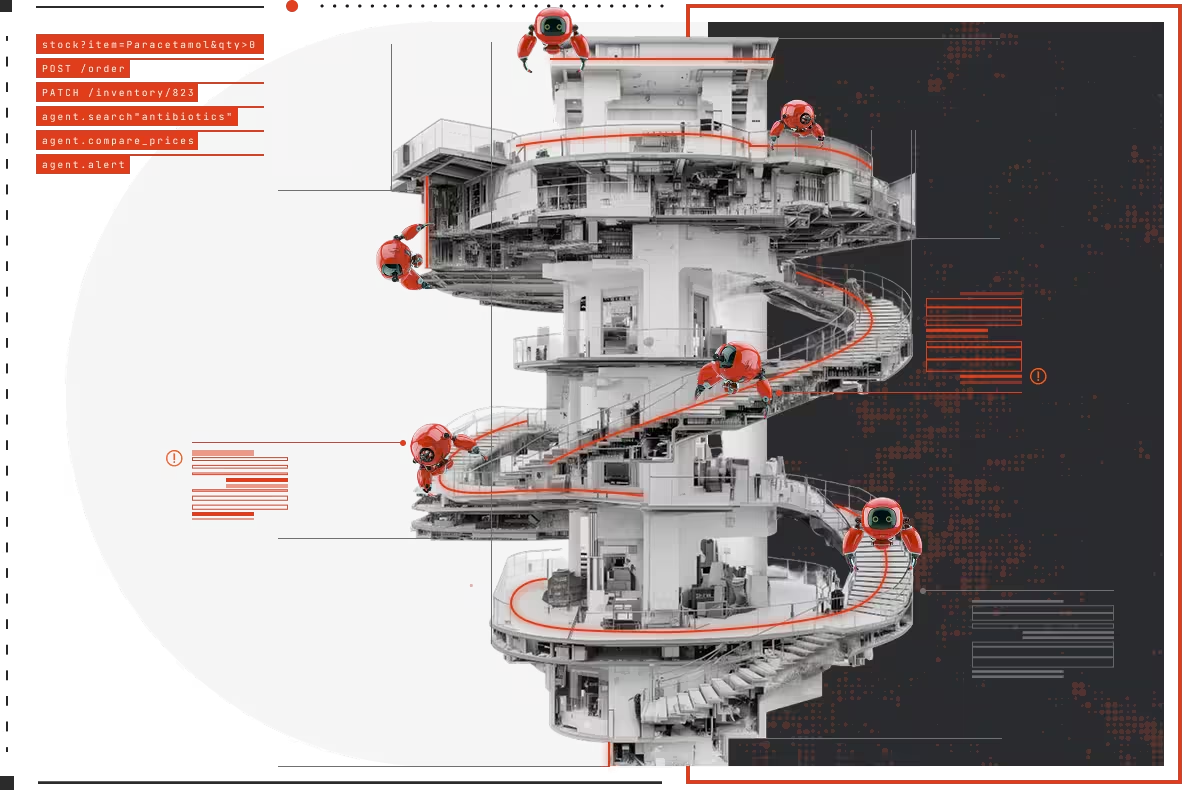
Agentic AI orchestration is the design and control of LLM-powered agents that can plan, call tools, validate outputs, and complete multi-step workflows. Instead of one-off prompts, you get a managed system: stages, roles, permissions, and monitoring.
We do both. We build AI workflow automation (the work gets done), and we add the orchestration (the control layer that makes it safe and reliable in production): sequencing, routing, approvals, retries, permissions, monitoring, and an audit trail. In short: automation delivers outcomes; orchestration makes it dependable.
A chatbot mainly answers questions. An agent can execute: it plans steps, uses tools (APIs, databases, ticketing systems), checks results, and produces auditable outputs, often without a human doing copy/paste work.
We use least-privilege permissions, policy checks, tool allowlists, validation stages, and human approvals where needed. Agents can think, but they can only act within controlled boundaries.
By designing the workflow to verify, not trust: retrieval with sources (RAG), structured outputs, deterministic validators, cross-checking steps, and evaluation on real inputs. Reliability comes from system design, not “better prompts.”
We add observability: traces, tool-call logs, state transitions, cost tracking, error reporting, and evaluation metrics. This makes agents debuggable, so you can replay decisions, find failure modes, and tune safely over time.
Yes, agentic orchestration is usually about connecting to your stack: REST/GraphQL APIs, databases, queues, ticketing, docs, and internal services. Agents operate through tools you approve, not by “guessing” from thin air.
It’s strongest for workflows with decision bottlenecks, exceptions, and cross-system coordination like document intake + verification, support triage, ops handoffs, compliance checks, quote/order processing, and data enrichment.
[ contact us/ ]
Thank You!
The ball's in our court now.
We'll get back to you within 24 hours.
By submitting, you agree to our Privacy Policy

Privacy is important to us, so you have the option of disabling certain types of storage that may not be necessary for the basic functioning of the website. Blocking categories may impact your experience on the website. More information
