
Seven software companies here have shipped real estate products for named clients, with results you can check:
- MEV: MLS and RESO-certified data platforms
- Ascendix: commercial real estate CRM
- Goji Labs: early-stage consumer products
- Taazaa: property management modernization
- OpenSource Technologies: white-label platforms on retainer
- Brocoders: rental platform rebuilds
- Inoxoft: AI for property operations
Scan the comparison table, use the buyer's guide to match one to your project, and read the reviews for the proof behind each pick.
When you build a real estate platform, the data layer is the tricky part, where a team without proptech experience can stumble.
Listing feeds have to reconcile against MLS (Multiple Listing Service) rules and stay inside IDX (Internet Data Exchange) display contracts, and how a listing is worded has to follow Fair Housing, the US law against housing discrimination.
So the proptech development companies worth shortlisting are the ones that have already built against those constraints. Seven stood out in the published work: MEV, Ascendix Technologies, Goji Labs, Taazaa, OpenSource Technologies, Brocoders, and Inoxoft. Each qualified the same way, by shipping a documented real estate product for a named client, and we scored every entry on that evidence.
One disclosure before you read on: MEV publishes this list and holds a spot on it, measured against the same bar as every other company here.
The 7 Best Proptech Software Development Companies at a Glance
How We Chose the Best Proptech Development Companies
We started with a pool of software firms that name property management software development
as a practice, drawn from industry directories and published roundups. From there, we kept only the companies that could prove the work.
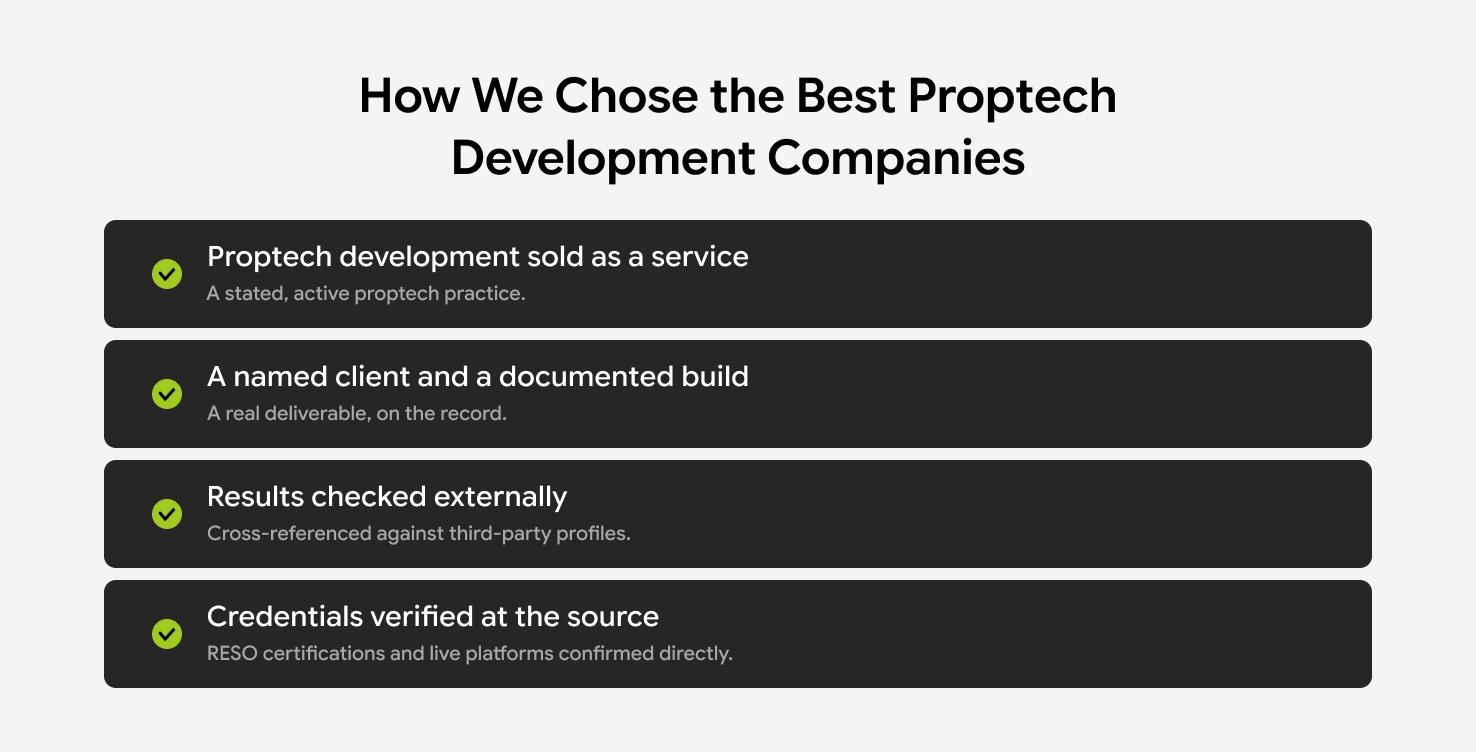
To make the list, a firm had to sell proptech development as a service and back it with a documented build. We required proof beyond a company's own marketing copy.
Where a build carried a credential like a RESO certification or a named platform in production, we confirmed it at the source. Firms whose proptech work we could not verify came off the list, whatever their general reputation.
What's left is a curated seven, each strong in a different corner of proptech, from MLS data platforms to self-storage SaaS. MEV publishes this piece and appears on it, held to the same evidence bar as the other six. Last reviewed September 2026, and refreshed as these companies' work changes.
The 7 Best Proptech Development Companies, Reviewed
The seven companies below each shipped a documented real estate build for a named client: MEV, Ascendix Technologies, Goji Labs, Taazaa, OpenSource Technologies, Brocoders, and Inoxoft.
1. MEV
MEV is a custom software development company that builds data-heavy platforms for regulated industries, headquartered in San Diego, CA. Its real estate practice focuses on MLS and RESO-certified data infrastructure: the MLS platforms, listing feeds, and Web APIs that real estate products run on.
MEV's main real estate project is Hawaii Information Service (HIS), the MLS provider for Kauai and Hawaii, which has been the MLS provider for Kauai and Hawaii since 1984. MEV has been rebuilding the HIS platform since 2018. It moved every user onto the new system with zero downtime and no data loss, and the platform now manages more than 600,000 properties.
MEV rebuilt the Web API, and it's now RESO Data Dictionary 2.0 certified, the standard for how MLS listing data is structured. The team also built a custom search engine on ANTLR4 and Elasticsearch that handles the 300+ filters agents use, without slowing down.
Best for: teams building MLS or RESO-compliant platforms, and real estate products where certified data compliance and zero-downtime modernization are hard requirements.
Proof: the HIS platform rebuild, a full MLS modernization with a RESO-certified Web API and a zero-downtime migration of every user.
2. Ascendix Technologies
Ascendix Technologies is a Dallas custom software firm, founded in 1996, that specializes in commercial real estate (CRE) technology. Its focus is CRM. Ascendix builds and customizes Salesforce and Microsoft Dynamics for brokerages, then layers its own CRE products, AscendixRE and Ascendix Search, on top.
Its highest-profile client is JLL, one of the largest commercial real estate firms in the world. Ascendix built JLL's CRM and moved it from on-premise to the cloud, and CRM adoption rose about sixfold. Other CRE clients include Transwestern, Stiles, and Hanna Commercial.
Best for: commercial real estate brokerages and investment firms that want CRM built on Salesforce or Dynamics, plus the reporting and mapping tools that sit on top.
Proof: a CRM build and cloud migration for JLL, plus its own AscendixRE and Ascendix Search product line.
3. Goji Labs
Goji Labs is a Los Angeles product studio that builds web and mobile applications with a strong focus on product strategy and UX. Real estate is one of its verticals, and its proptech work centers on early-stage, consumer-facing platforms.
Goji has two published real estate builds. The first is Gitcha, a reverse real estate marketplace where buyers post what they're looking for and owners or agents reach out to them. Goji ran user research with buyers, sellers, and agents before designing and building it. The second is Pocket, an $11M-funded real estate transaction platform that automates listings and organizes property data for buyers.
Best for: early-stage proptech founders who need to validate an idea and ship an MVP, whether a marketplace or a consumer app.
Proof: two consumer real estate products taken from research through launch, Gitcha and Pocket.
4. Taazaa
Taazaa is a product engineering firm, headquartered in Hudson, Ohio with a real estate practice built around property management and legacy modernization. In proptech, its strength is taking dated systems and rebuilding them for scale.
Taazaa's proptech clients include Innago, a landlord and tenant management platform. For Tropicana Properties, which manages 40 apartment complexes of market-rate and low-income units in El Paso, Taazaa took over a custom property app that an earlier vendor had struggled to stabilize.
It rebuilt the app on a current .NET framework, which cut the manual monthly fixes to tenant payment records by about two-thirds.
Best for: US property operators and proptech companies modernizing legacy property-management software, including portfolios with affordable and low-income units.
Proof: a .NET modernization for Tropicana Properties that cut manual fixes to tenant records by about two-thirds.
5. OpenSource Technologies
OpenSource Technologies (OST) is a women-led custom software firm in Lansdale, Pennsylvania. It works across several sectors, including education, government, healthcare, and real estate, and most of its work runs as long-term retainers.
In real estate, OST builds multi-tenant, white-label platforms. Its anchor engagement, White Label Storage, runs 350+ self-storage facilities on one shared backend, each branded site with its own theming, isolated data, and centralized billing.
OST lists five active real estate clients across three sub-verticals: commercial real estate, residential brokerage, and self-storage.
Best for: operators launching a multi-tenant, white-label real estate or self-storage platform, and teams that want a long-term engineering partner on retainer.
Proof: White Label Storage, a multi-tenant platform running 350+ self-storage deployments, plus automated property-data extraction from PDF offering memorandums.
6. Brocoders
Brocoders is a proptech-focused software company, based in Estonia that develops and rebuilds platforms for property and rental businesses. Its work spans short-term rentals, listing tools, and management software for HOAs (homeowners associations, the bodies that run condo buildings and planned communities).
Its strongest result is Lake, a US vacation-rental platform whose backend couldn't scale past about 500 connected properties. Brocoders redesigned it in three months, and the platform grew to 40,000 connected properties.
Best for: rental and community-housing platforms that have outgrown their original architecture and need a backend that scales.
Proof: a three-month backend rebuild that took Lake, a vacation-rental platform, from about 500 to 40,000 connected properties.
7. Inoxoft
Inoxoft is a ISO 27001-certified custom software company, with US offices and delivery teams across Europe. In real estate, it focuses on property-management software, tenant tools, and AI for property operations.
Inoxoft builds AI agents for property operations that read maintenance requests, including free-text messages and photos, draft the work order, and route it to the right vendor for one-click approval.
It offers tested AI modules for maintenance, pricing, scheduling, and lease parsing, designed to scale across large portfolios.
Best for: property operators and proptech teams that want to automate maintenance and tenant operations with AI, layered on top of existing systems.
Proof: AI maintenance and operations agents for property-management platforms, including request triage and automated vendor routing.
How to Choose a Proptech Development Company
The right company depends on your project stage and your data constraints. A firm that ships consumer MVPs and a firm that rebuilds MLS platforms are experienced at different things. Four questions can narrow the field and help you make that decision.
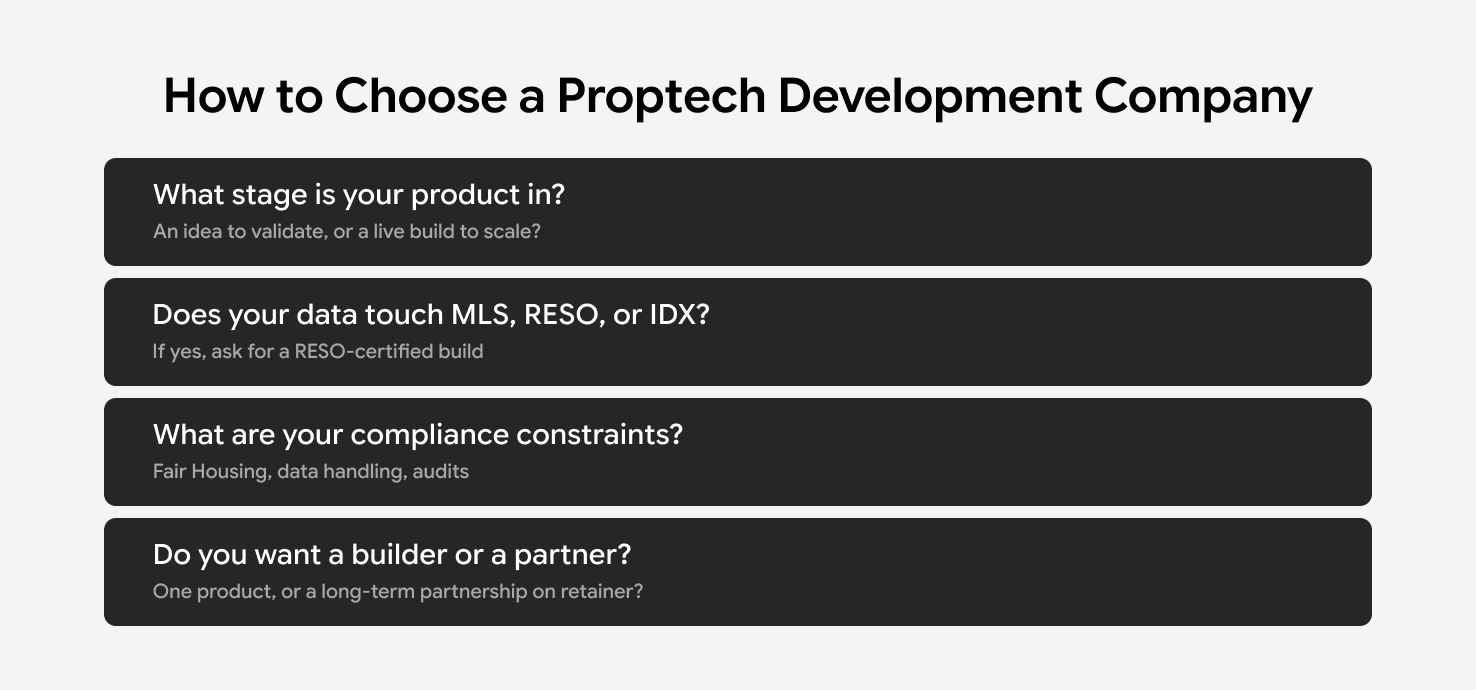
What stage is your product in?
An early idea needs discovery and MVP work to validate the concept before a full build. A live platform buckling under growth needs modernization and rebuilding experience. The two are different skill sets, so it's worth checking which one a company has shipped.
For early validation, MEV runs an Innovation Lab and Goji Labs is built for the same early-stage work.
For a rebuild under load, the fit depends on the system: MEV for large-scale data and MLS platforms, Taazaa for legacy property-management modernization, Brocoders for consumer rental platforms outgrowing their backend.
Does your data touch MLS, RESO, or IDX?
Listings pulled from an MLS need to follow strict rules: the RESO Data Dictionary sets how listing fields are structured, and IDX contracts govern what you can display.
Ask if the company has handled MLS integration and IDX integration before, and if they've delivered a RESO-certified build. MEV holds a RESO DD 2.0 certification on the HIS platform.
Is compliance a hard requirement?
Real estate carries Fair Housing rules on how listings are worded and displayed, plus accessibility obligations that vary by market. For any platform that handles tenant screening or pricing, it's worth asking how the company has handled Fair Housing and ADA in the past. A named prior build is the answer you ideally want.
Do you want a project team or a long-term partner?
Some engagements ship one product and end. Others run for years as the product grows and changes. That difference shapes who you hire: a project studio and a retainer firm work differently once launch is behind you. For instance, OpenSource Technologies and Inoxoft both work mainly on long-term retainers, as their core engagement model.
Once you've answered these four questions, the shortlist becomes truly short. Verify what you can on your own, then reach out. How a company communicates and runs its process is something you can only judge in the conversation.
The Bottom Line: Which Proptech Development Company Is Right for You?
Each of the seven here is the strongest pick for a different kind of build, so match the list to your situation.
If your platform runs on MLS data and has to meet RESO or IDX rules, MEV is the specialist, with a RESO DD 2.0 certification behind it. For commercial real estate CRM, Ascendix has the deepest track record and its own products.
Goji Labs fits early-stage founders validating a consumer idea. Taazaa and Brocoders both rebuild platforms that have outgrown their architecture, one in property management, the other in rentals.
OpenSource Technologies suits operators who want a multi-tenant white-label platform on a long-term retainer. Inoxoft is the pick for adding AI to property operations.
Whichever way you go, verify what you can and reach out. The rest becomes clear once you're on a call with them.
We wrote this for teams choosing a real estate software development company to build or modernize a product, who need to tell proven proptech delivery from a sales pitch. Every company here sells proptech development as a service and backs it with a documented build for a named client.
For each finalist we investigated the case studies and checked the client names and results against third-party profiles. Where a build carried a credential like a RESO certification or a named platform in production, we confirmed it at the source. Firms we couldn't verify came off the list, whatever their reputation. MEV publishes this list and appears on it, measured against the same bar as every other company.
.avif)