

[ client & product overview/ ]
The client is building a SaaS platform for enterprise technical training. Users upload technical documentation such as manuals, standard operating procedures, and presentations, and the platform transforms it into structured courses with lessons, quizzes, slides, diagrams, narration, and video.
A core requirement is traceability. Key points, figures, and quiz questions maintain direct links to their source documentation, allowing subject-matter experts to verify accuracy.
Before partnering with MEV, the client had built a working prototype using Replit and AI-assisted development, validating the concept on real-world training materials.
[ productionization scope/ ]
Productionize a Replit AI application without a full rewrite
Make long-running AI generation recoverable
Make AI-generated training traceable to its source
Keep courses up to date when source documentation changes
Add subscription billing with API-enforced plan limits
Scaled the prototype into an enterprise training SaaS product
Keep rapid Replit experimentation connected to controlled production development
[ how we did it/ ]
MEV first stabilized the high-risk operational areas: deployment, authentication, database management, testing, and runtime infrastructure.
The team replaced the prototype authentication with Clerk and added Creator, Learner, and Administrator roles, plus registration moderation, invitations, and per-course access controls. Database changes moved to SQLAlchemy and Alembic, resulting in 35 versioned migrations.
MEV also introduced automated testing and CI. At hand-off, the server test suite contained 1,920 unit and API tests across 128 files, with about 60% written by MEV engineers. External services are mocked in tests, and the suite runs on every pull request.
The production environment moved to AWS using ECS Fargate, S3, CloudFront, ElastiCache, and CloudWatch. GitHub Actions handles automated builds and deployments to AWS. Development deploys automatically, while production releases are deployed manually after founder approval.
Course generation can take up to an hour, with document analysis adding another 10 to 20 minutes. In the prototype, this work ran inside the web server, so a restart could terminate an active generation job.
MEV moved generation into three separate processes and split the main workflow across five queues, each configured around the limits of the external services it uses.
The system saves progress throughout the workflow, allowing interrupted jobs to resume instead of starting over. Stalled jobs are requeued automatically, workers scale separately from the web app, and provider-specific limits prevent one slow service from blocking the rest.
Source traceability starts when a document enters the system. The core pipeline already existed in the Replit prototype, and MEV focused on making it reliable for production.
Landing.ai splits uploaded documents into structured fragments and preserves page and position data for headings, text, tables, formulas, and figures. Cohere Embed via AWS Bedrock creates embeddings for those fragments, which are stored in PostgreSQL 16 with pgvector
MEV improved retrieval reliability through retrieval fixes, reference evaluation, and pipeline validation.
As a result, key points, figures, and quiz questions can stay linked to the source fragments they were generated from, allowing users to open and verify the original material.
MEV hardened selective regeneration for web-sourced courses by adding concurrency controls and stale-job recovery.
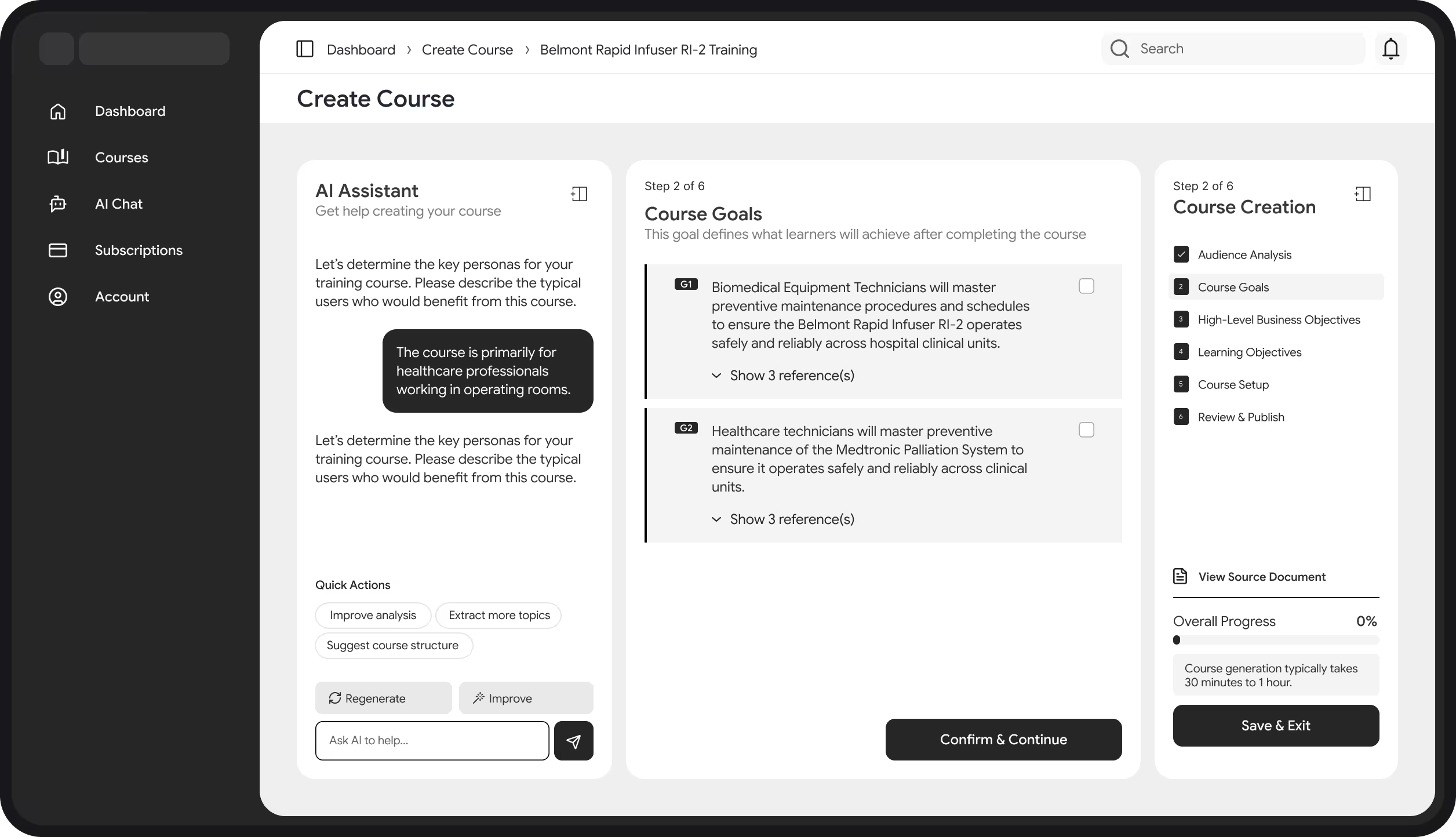
Much of the instructional-design logic already existed in the prototype. MEV rebuilt the Creator experience as a step-by-step flow for defining the audience, goals, course length, and learning objectives before generation. The workflow uses established instructional-design frameworks, including Dick and Carey, ABCD, and Bloom's taxonomy. Assessments are defined before the corresponding lessons, and the platform also flags gaps or contradictions in the source material that could affect the course.
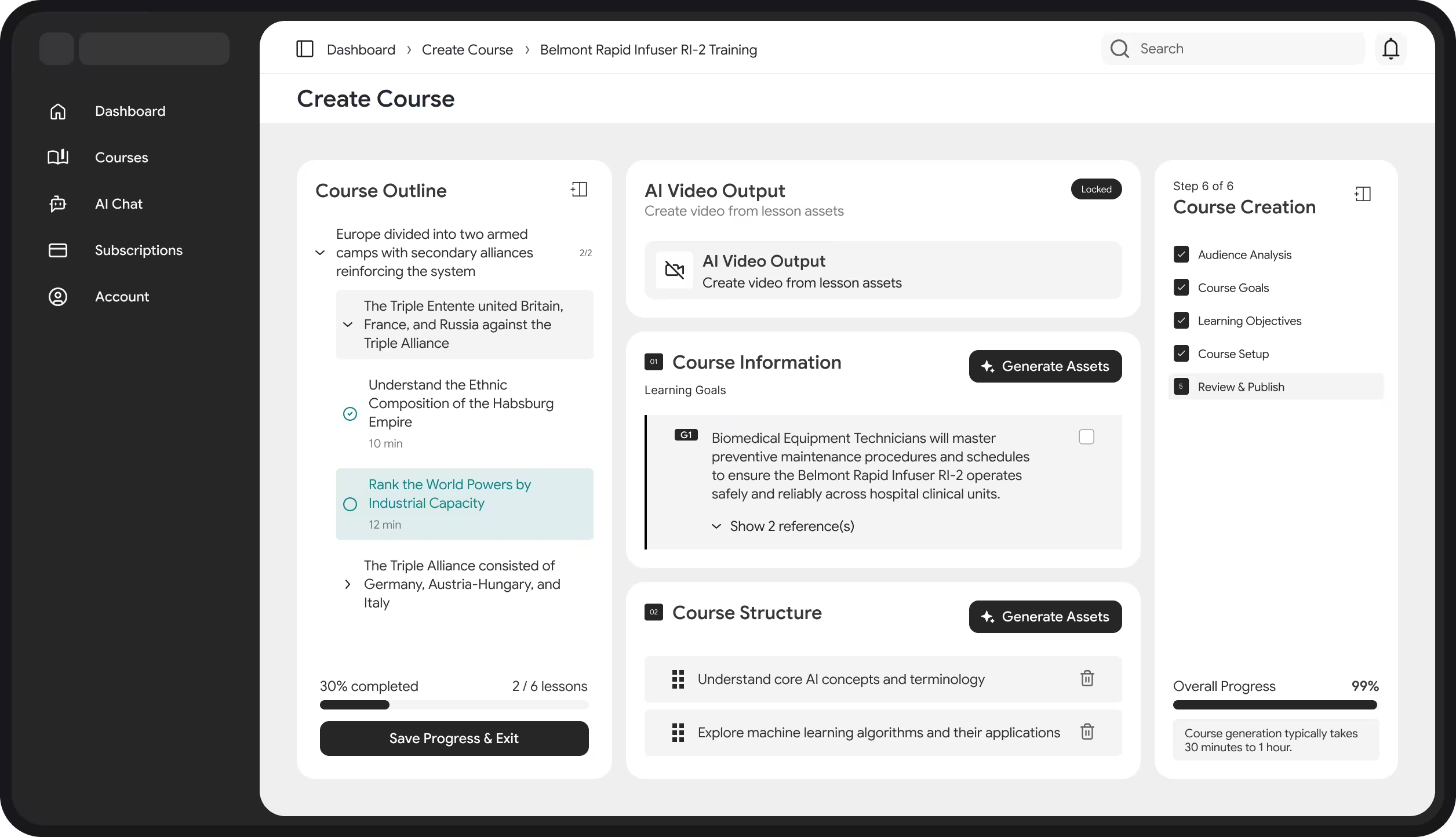
Creators can work with PDF, DOC, DOCX, PPT, and PPTX files, with Office documents converted on the server using LibreOffice. Supported documentation websites can also be used as source material. Generated courses can include 10 slide types and 11 diagram types, plus quizzes, inline exercises, narration, narrated slideshow video, and optional AI-avatar introductions. Numeric examples also receive a programmatic arithmetic check rather than relying only on the language model.
Creators can edit generated text, replace figures with assets from the original source document, and regenerate individual content blocks without rebuilding the whole course. The platform also supports in-course comments and discussions, with permissions controlling who can view or participate.
Learners get lesson-level progress tracking, saved quiz results, and resume support. A built-in course assistant answers questions using course materials, cites relevant lessons, recommends what to review next, and accepts PDF and image attachments as additional context.
Courses can be published to the web or exported as SCORM 1.2 packages for use in an existing LMS, including quiz-result reporting back to the LMS. The platform also supports downloadable ZIP archives and embedding source-document fragments on external sites.
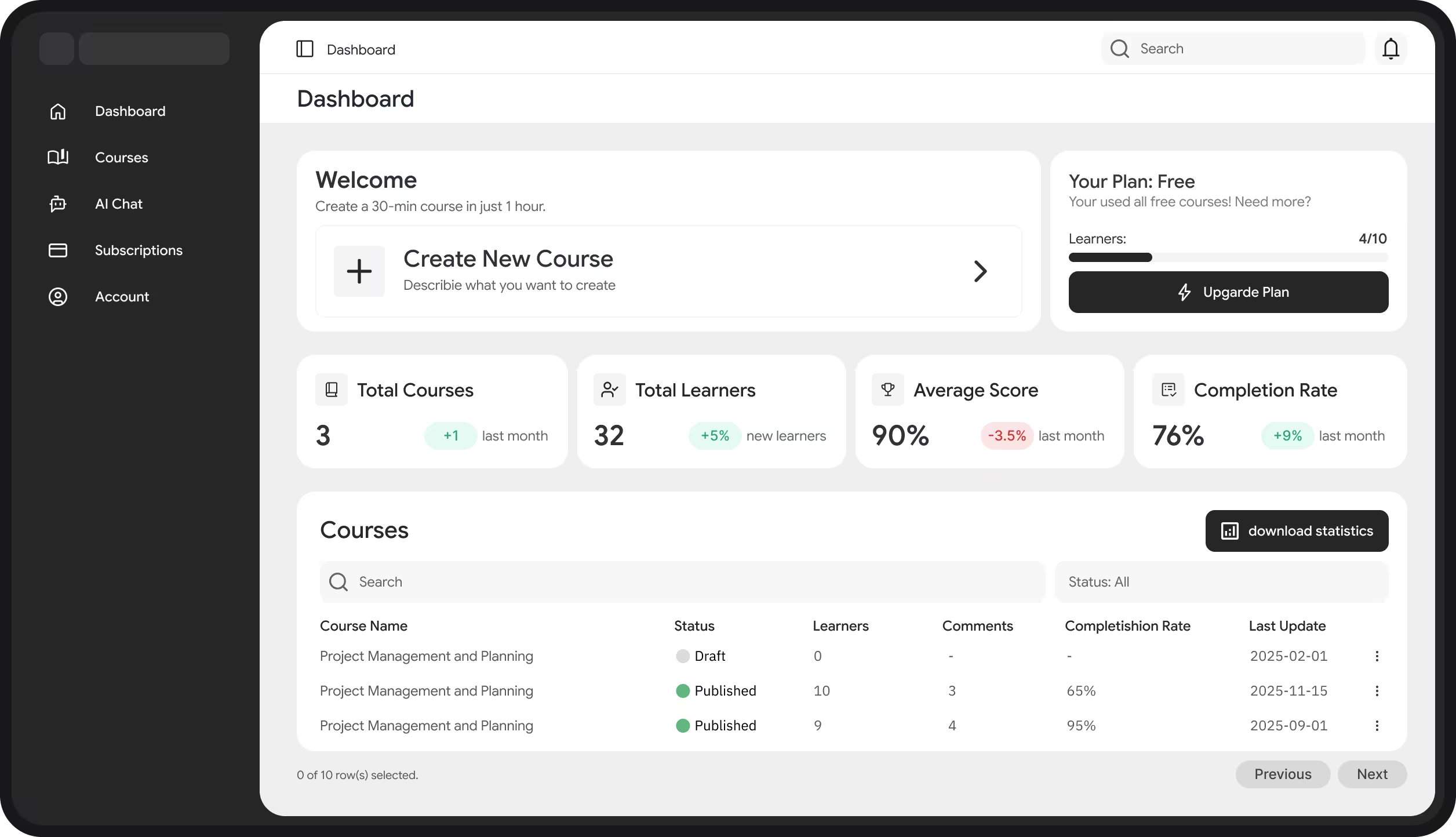
The SaaS product includes three plan tiers, two paid through Stripe. Course limits and invited-learner limits are enforced at the API layer rather than only in the interface.
The platform tracks AI-generation costs across five paid providers and shows cost by course and provider. The client-side developer built this cost-accounting capability.
Quality control combines automated and human review. Before releases, MEV's QA engineer runs the full generation flow against real documents and reviews the resulting courses. The client team also built a Claude-based evaluator that scores finished courses against defined quality criteria.
Replit remained the client's sandbox for AI-assisted experimentation after the production environment moved to AWS.
MEV kept that experimentation separate from the production path. The founder continued working in Replit, while the client's second developer used regular feature branches and pull requests. All changes went through review before reaching AWS Dev and production.
The repository also included AI-agent instruction files such as replit.md and AGENTS.md, which defined rules for migrations, authentication, API conventions, and other coding standards.
Across the engagement, the project recorded 334 merged pull requests and 16 production releases.
[ technology/ ]
Frontend
Backend
Data & AI
Infrastructure
[ portfolio/ ]
[ contact us/ ]
Thank You!
The ball's in our court now.
We'll get back to you within 24 hours.
By submitting, you agree to our Privacy Policy

Privacy is important to us, so you have the option of disabling certain types of storage that may not be necessary for the basic functioning of the website. Blocking categories may impact your experience on the website. More information