

Capgemini puts 2% of organizations running AI agents at scale and 61% still exploring, so most buyers are picking a partner before they have much in-house agent experience to draw on.
The article profiles seven companies that build agentic systems day to day and compares them on three aspects: delivery profile, stack and architecture, and typical implementation scope.
The seven companies are MEV, Brocoders, Itransition, 10Pearls, Coherent Solutions, Saritasa, and Belitsoft.
To choose, start from the system you are building. Agents that move across several systems and hold state need orchestration and observability depth, while agents that answer from your own documents need retrieval grounding and source traceability.
An agentic AI development company builds software agents that plan a task and then act on it across business systems, under human supervision. Companies hire these firms when an AI feature has to run inside production workflows with permissions and monitoring in place.
This guide ranks the top agentic AI development companies in 2026 on delivery model and typical project scope.
Where Does AI Agent Adoption Stand in 2026?
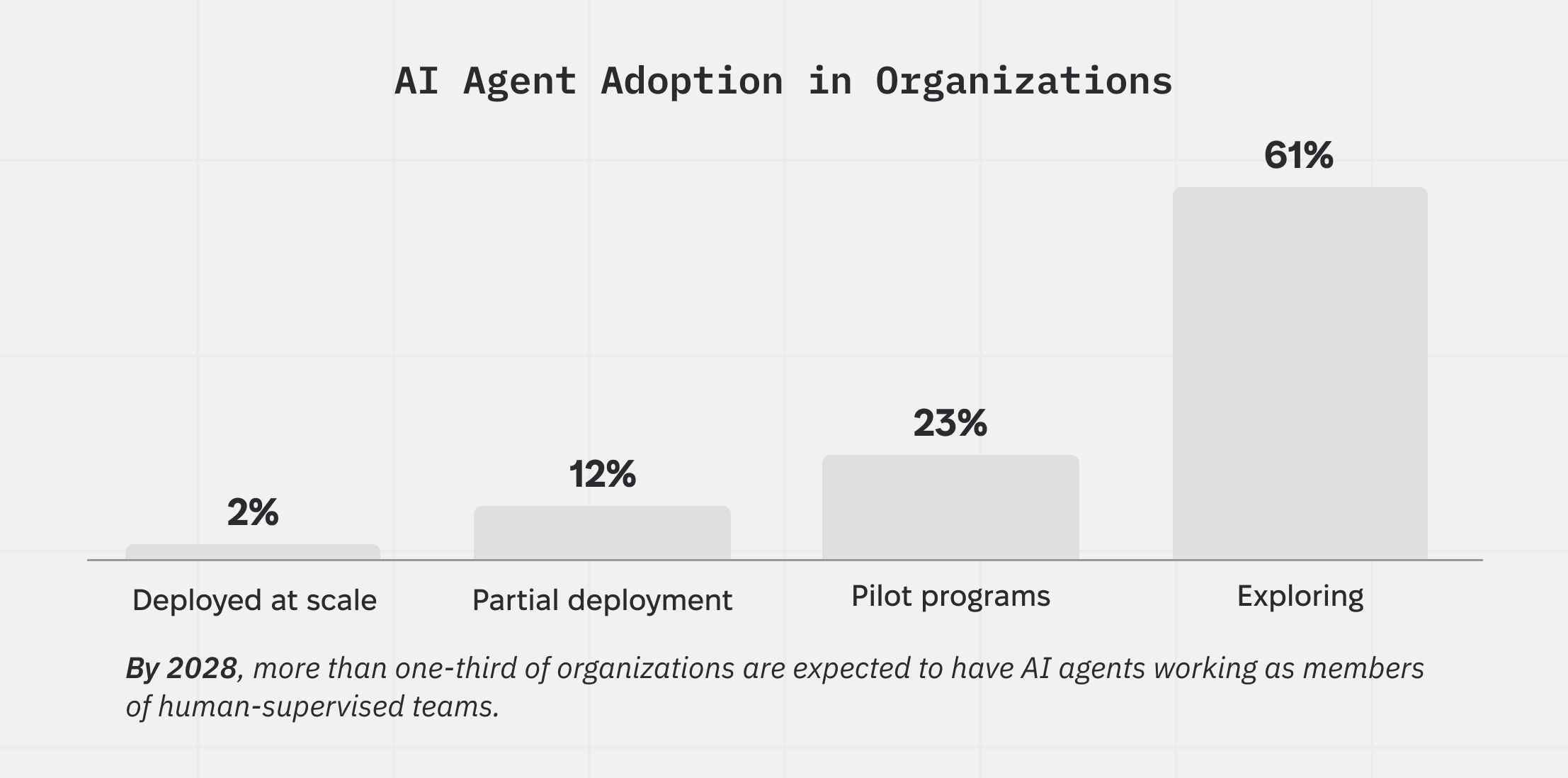
Capgemini reports that 2% of organizations have deployed AI agents at scale, 12% at partial scale, 23% are running pilots, and 61% are still exploring deployment. It also expects adoption to accelerate: by 2028, more than one-third of organizations will have AI agents working as members of human-supervised teams.
Most companies will start by assigning agents to specific operating tasks. In finance, that means invoice extraction, PO matching, exception flagging, and draft ERP posting. In support, it means ticket classification, CRM lookups, knowledge-base retrieval, routine case resolution, and summarized escalation. In engineering, it means codebase search, test drafting, release-note generation, and CI-linked delivery support. The next step will be multi-stage workflows such as claims handling, procurement coordination, and service resolution across several systems.
As agent use expands from narrow tasks to broader operational workflows, many organisations reach the same decision point: build the capability in-house or work with a team that already knows how to deliver it. The rest of this article looks at seven companies that work with agentic systems day to day, how they design and ship these solutions, and where each of them tends to fit best.
MEV: agentic workflows for data-intensive products
MEV is a custom software development company that builds agentic AI systems into working products. It suits companies that want AI features shipped into software they already runs. Its AI offering covers custom AI/ML development, generative AI, integrations, and agentic workflows, with a clear emphasis on turning those capabilities into usable product features. The stack it highlights is practical and current, including OpenAI, Anthropic, Gemini, Llama, LangChain, MCP servers, n8n, and major cloud platforms.
What stands out is MEV’s focus on workflow design and control. Its agentic orchestration model breaks work into stages, assigns roles such as extractor, planner, auditor, and executor, then adds routing, permissions, observability, testing, and production monitoring. The tooling it lists points to stateful, data-heavy systems: LangGraph, CrewAI, AutoGen, Temporal, BullMQ, REST and GraphQL integrations, Pinecone, pgvector, Postgres, and monitoring tools such as Langfuse, LangSmith, Arize Phoenix, and Sentry. That makes sense for products where an agent has to move across several systems, keep state, and remain debuggable in production.
Brocoders: production-grade AI agents grounded in real data
That matters when the AI sits in front of customers. Brocoders built AskAC.ai for CompressorWorld on its Bridge platform, an assistant that answers industrial compressor questions around the clock from more than 4,000 indexed manuals, with each answer linked back to the source manual. For GoodCar.com, Brocoders built a conversational agent for used-car research that carries cross-session memory and image-based VIN scanning. For Perspection.ai, the team delivered multi-agent orchestration with 3 to 5 AI personas moderated by an AI facilitator across structured decision rounds.
For companies past the prototype stage, the appeal is practical: retrieval-grounded answers, multi-agent workflows, and AI features that hold up in production.
Itransition: broad GenAI portfolio for complex systems
Itransition has a broad AI and GenAI service portfolio. Its public offering covers custom AI development, generative AI, chatbots, RAG-driven assistants, and AI agent development across healthcare, finance, insurance, telecom, manufacturing, automotive, retail, and software.
This profile fits complex environments where AI is only one layer of a larger transformation program. In Itransition’s case, assistants, retrieval, and workflow automation sit within the same delivery model. The practical implication is direct: assistants handle interaction, retrieval brings in internal context, and orchestration turns both into multi-step flows that can query systems, move data, and support business operations.
10Pearls: product-oriented generative and agentic AI
10Pearls is built around digital product delivery, with AI positioned as part of product design, engineering, and release work rather than as a separate research track. Its public offering covers generative AI development, agentic AI development, AI consulting, and product engineering, which aligns well with teams building customer-facing products and AI-enabled software features.
One of the practical strengths here is speed. 10Pearls frames its GenAI work around early assessment of data, infrastructure, and risk, then moves quickly into implementation with verification layers, fine-tuning, and controls aimed at reducing hallucinations.
That approach suits rapid POC work: test a narrow use case, validate the data path, measure output quality, and only then expand the feature across the product.
Coherent Solutions: agentic AI inside existing software ecosystems
Coherent Solutions develops AI capabilities as part of broader product engineering work. Its AI services include generative AI, conversational systems, analytics solutions, and enterprise AI integrations, with a focus on embedding these capabilities into existing software products and platforms.
Typical implementations involve conversational interfaces, AI-assisted content generation, and analytics systems connected to operational data. In these environments, AI components interact with internal services, data platforms, and business applications such as CRM systems or internal knowledge bases. The agent layer coordinates tasks such as retrieving internal information, generating responses, and triggering actions in connected systems.
Saritasa: AI agents across web, mobile, and IoT stacks
Saritasa works at the point where AI, application development, and connected systems meet. Its capabilities cover custom AI development, chatbots, IoT software, system architecture, and API integration, which is relevant when agentic systems need to operate across both software platforms and physical devices.
This becomes important in projects where agents interact with sensor data, connected hardware, or field workflows. In those environments, an agent may need to process telemetry, surface alerts, trigger actions through integrated systems, or prepare operational context for a human team. Saritasa’s work includes an AI-enabled voice assistant for RV control and monitoring, alongside broader IoT and fleet-related software delivery.
Belitsoft: LLM-centric development and agentic workflows
Belitsoft focuses heavily on LLM work at the foundation level: training, fine-tuning, prompt engineering, and domain-specific assistants. Its AI services explicitly cover custom LLM training and development for chatbots, internal assistants, and industry-specific use cases built on proprietary data.
That matters in projects where the model layer needs adaptation before the workflow layer starts to matter. In practice, this usually means assistants grounded in company data, tuned for domain terminology, and connected to internal systems through retrieval, APIs, or custom logic. Belitsoft also describes end-to-end AI agent development that includes data preparation, architecture design, implementation, testing, integration, deployment, and production support.
In an agentic setup, those pieces combine into a wider pipeline: an LLM handles interpretation and generation, retrieval brings in business context, and the agent layer coordinates actions across tools and systems. Belitsoft’s profile fits companies that need serious LLM customization without the cost profile of a large enterprise integrator.
How So the Seven Agentic AI Companies Compare?
Outlook beyond 2026
By 2027 and 2028, the strongest systems will look less like open-ended assistants and more like bounded operators: they will have narrow tool access, explicit approval points, replayable traces, and hard limits on what they may change. Gartner’s forecast cuts both ways: it expects more than 40% of agentic AI projects to be canceled by the end of 2027, but also expects agentic AI to appear in 33% of enterprise software by 2028 and handle 15% of daily business decisions.
A second important change is standardization at the tool layer. In 2025, MCP started to matter because agent builders were tired of writing one-off integrations between models and business systems. In December 2025, Anthropic donated MCP to the Linux Foundation’s new Agentic AI Foundation, where it joined AGENTS.md and other foundational projects under neutral governance. That raises the odds that agent stacks will become more portable across models, tools, and vendors. For buyers, this matters because the next lock-in risk is no longer only the model provider. It is the proprietary runtime sitting between the model and the systems it can act on.
Architecture is also getting more opinionated. Microsoft’s guidance already treats orchestration patterns such as sequential flows, concurrent workers, handoffs, and group-chat coordination as first-class design choices, not implementation details. That is where the field is heading: fewer all-purpose agents, more graph-based systems with task decomposition, state management, and recovery logic. In practice, agent development is starting to resemble workflow engineering with LLMs inside it, not magic autonomy layered on top of an API.
Security will get much sharper. In January 2026, NIST opened an RFI focused specifically on securing AI agent systems that can take actions affecting external state. That is an important distinction. Once an agent can update records, trigger workflows, or move money, the main question is no longer whether the model answered well. The question is whether the system can constrain authority, verify actions, resist prompt injection, and keep an audit trail that survives an incident review. Beyond 2026, serious agentic systems will be judged more by permission design, identity controls, and action-level logging.
After 2026, buyers will ask tougher questions about execution, not just model output. Deloitte’s 2026 outlook highlights legacy integration as a core blocker, and that is probably the right dividing line for the vendor market. The stronger companies will be the ones that can connect agents to ERP, CRM, ticketing systems, data platforms, and approval workflows without creating cost spikes, latency problems, or control gaps. Vendors that solve legacy integration will win the deals that expand past a single workflow.
How Do You Choose an Agentic AI Development Company?
Your systems set the requirement here. OpenAI appears in the MEV, Brocoders, and Coherent Solutions stacks alike, which makes the model list a weak filter. The stack column is where these seven separate: Temporal and LangGraph for staged execution at MEV, fine-tuning and on-prem deployment at Belitsoft.
Two questions narrow a shortlist quickly. The first: what happens when an agent fails mid-workflow? A vendor that can walk you through retries and human handoff has run these systems in production. The second: who owns the runtime? A proprietary orchestration layer you cannot inspect becomes the lock-in that outlasts whichever model you pick this year.
One workflow that crosses two systems makes a good first engagement. You review the traces yourself and see how the team handles the parts that break.
MEV builds custom agentic AI development services around staged execution and traces you can replay after a failure. Contact us to walk through your workflow and integration constraints.
References
- Rise of agentic AI: How trust is the key to human-AI collaboration (Capgemini Research Institute).
- Gartner Predicts Over 40% of Agentic AI Projects Will Be Canceled by End of 2027 (Gartner, June 25, 2025).
- Linux Foundation Announces the Formation of the Agentic AI Foundation (AAIF) (The Linux Foundation, December 9, 2025).
- AI agent orchestration patterns (Microsoft Learn, Azure Architecture Center, updated February 12, 2026).
- CAISI Issues Request for Information About Securing AI Agent Systems (NIST, January 12, 2026).
- The agentic reality check: Preparing for a silicon-based workforce (Deloitte Insights, Tech Trends 2026, December 10, 2025)
We wrote this because the agentic AI vendor market is hard to read from the outside. Most companies publish similar service lists, and the differences show up in how they design orchestration and what they can connect an agent to. We build agentic workflows ourselves, so we spend our days inside those questions and have a close view of who else does this work.
Full disclosure: this is our list, and we rank first on it. Every company here, MEV included, is described from public material, service pages and published case studies, so you can check the same sources and reach your own order.
What does an agentic AI development company do?
An agentic AI development company designs and builds AI agents that plan multi-step tasks, call tools and APIs, and act inside business systems. The work covers orchestration, permissions, testing, and production monitoring.
What do custom agentic AI development services include?
Custom agentic AI development services cover workflow design, agent role definition, tool and API integration, retrieval setup, guardrails, and observability. Most engagements start with one narrow workflow before expanding across systems.
Should we build AI agents in-house or hire a vendor?
In-house builds work when your team already runs LLM systems in production. Vendors fit when the blocker is integration with ERP, CRM, or ticketing systems your engineers have not instrumented for agent access.
What should we ask an agentic AI vendor before signing?
Ask how the vendor constrains agent authority, how actions get logged, and what happens when an agent fails mid-workflow. Ask to see a replayable trace from a live system.
How long does an agentic AI proof of concept take?
Timelines run from a few days to several weeks depending on data readiness and system access. MEV shipped a working PoC in 72 hours using a gated pipeline of single-job AI agents with engineer sign-off at each stage.