
Technical due diligence tells search fund and ETA (Entrepreneurship Through Acquisition) buyers what condition the target's software is in before they close, and what fixing it will cost. Searchers rarely have an in-house CTO to check the code themselves, so anything the review misses turns into a repair bill after closing.
MEV runs buy- and vendor-side technical due diligence for software targets in two to four weeks at a fixed fee of $5,000 to $30,000, based on target complexity and deal scope.
Whether you raise equity from investors as a traditional searcher or borrow against the target as a self-funded one, you are making a single concentrated acquisition, and your whole return depends on it. You read the financials yourself and take engineering on trust. The founder or the development team that built the platform leaves after the sale. Once you close, you own every bug and security gap they left behind.
Technical due diligence (TDD) is a review of a company's codebase and infrastructure, plus the engineering team behind them. It shows you what you are buying before you wire the funds, down to whether the platform can carry the growth plan in your model.
Whether you need a full review, and how deep it should go, depends on how central the software is to the business.
At MEV, we run technical due diligence for software acquisitions in regulated sectors, with most of our work in healthcare, data, and AI. We scope each review to the deal and quote a fixed fee before you commit.
Do Search Funds and ETA Buyers Need Technical Due Diligence?
Most search fund and ETA software acquisitions need technical due diligence. The exception is a company that mainly resells a platform someone else builds and maintains, where the vendor handles the fixes, and a lighter check covers you.
Six signals tell you an acquisition target needs technical due diligence:
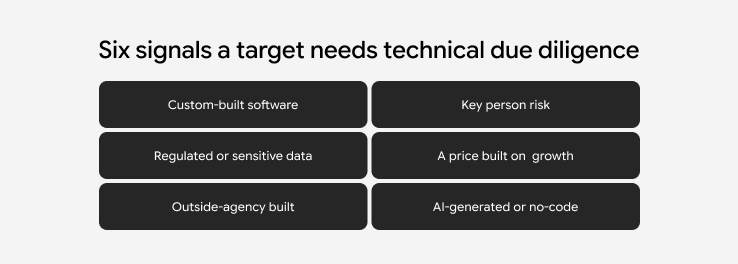
- Custom-built software.
Every future patch and update requires dedicated engineering headcount, an expense you must take into account before closing. - Key person risk.
When one person builds and maintains the platform, their exit removes the only person who understands the system. - Regulated or sensitive data.
If the software handles health records or payments, its compliance gaps become your liability. - A price built on future growth.
You are paying today for users the system hasn't handled yet, and the TDD review tells you if the code can support them in future. - An outside agency built the product.
IP ownership usually trails through multiple contractors, so you must trace every agreement to confirm the seller holds the rights. - Reliance on AI-generated code or no-code platforms.
Unhardened AI code scripts and visual workflows often lack basic security controls, rate limiting, and maintainable test coverage. These become your immediate post-close rebuild costs.
A searcher is far more exposed than a corporate buyer. You have no internal tech team to fix sudden bugs and no second asset to spread risk across. If your technical due diligence misses a structural flaw, the repair bill comes directly out of your equity returns.
What Does Technical Due Diligence for a Search Fund Cover?
Technical due diligence for a search fund inspects four things: the source code, the architecture it runs on, its security and compliance, and the engineering team behind it.
The review surfaces M&A technical risks you would otherwise inherit at closing, while you can still price them in or walk away.
What does a code audit review?
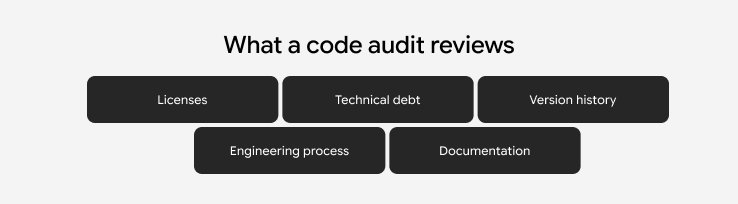
A code audit reads the codebase to answer two questions: what you legally own, and what it will cost to keep the software running. It covers licenses, technical debt, engineering process, documentation, and version history.
The Linux Foundation cites an estimate that open-source components make up 70 to 90% of modern software, so a large share of what a searcher pays for arrives with license terms someone else wrote.
Those inherited licenses carry strict license compliance terms. Certain copyleft licenses, such as GPL or AGPL, require you to open-source your own proprietary code if you distribute the software, which can wipe out the commercial value you are paying for. A code audit flags which licenses the target relies on and identifies any restrictions that impact how you sell or host the product.
The audit also sizes technical debt: the shortcuts and aging dependencies you have to pay down before the product can scale.
While that picture tells you what shape the code is in today, reading the process around the code reveals if the debt will keep piling up after you take over. The M&A due diligence process checks if the acquisition target documents coding standards and if anyone reviews code before it merges.
The audit also involved automated checks. Linters and static analyzers inspect code without running it, catching flaws before an engineer reviews the work. A repository without them has no automated enforcement of any coding standard.
Documentation determines how fast your first hire becomes productive, so the audit checks what the codebase says about itself, examining README files and API specifications in OpenAPI or Swagger form. If past teams built parts of the system without recording their work, your new developer will need to reconstruct the architecture from the raw code before shipping anything new.
Version control shows how the system evolved. When a company logs every commit, you can see who changed what and when, and you can restore code if files are lost. A repository with a thin or rewritten history leaves you the code and no record of how it got there.
When that history is thin, the only record of how the software got here lives with the person or team who wrote it. Roman Beylin, founder of DueDilio, names single-developer reliance and key-person risk as one of the key risks in an SMB acquisition. In a search fund deal, that person is often the seller and they leave shortly after closing.
Who legally owns the code?
Proprietary IP ownership is a separate question from licensing. A license sets the terms for using someone else's code. Ownership covers the code the seller's team wrote, and their right to transfer it to you.
If the seller relied on offshore contractors or freelancers and never signed intellectual property assignment agreements, parts of the codebase may not transfer with the sale. The review checks who wrote the code and if the company holds IP rights to what you are paying for.
The target's cloud contracts and customer licenses can carry change-of-control clauses that let the counterparty renegotiate or walk when the company changes hands. The review lists which agreements the product depends on and flags the ones that trigger on a sale, so your lawyer knows where to look before you sign.
How Much Does Technical Due Diligence Cost for a Search Fund?
Technical due diligence for a search fund typically costs a flat $5,000 to $30,000 and takes two to four weeks to complete.
Where your deal falls in that range depends on two main factors:
- Software reliance and risk.
A product where software is the core value proposition like a B2B SaaS platform or a regulated healthcare portal needs a deep review of its architecture and security. If it handles regulated data, the review also covers compliance. An unregulated company that uses off-the-shelf tools needs much less. - Codebase complexity.
The volume of custom code and the number of integrations drive how many hours engineers spend auditing the system. Thin technical documentation adds more.
Axial's 2025 Dead Deal Report, which examined 75 broken lower-middle-market deals, found that diligence findings outside the quality of earnings review were the single most common reason a deal fell apart, at 25.3% of failures, ahead of financing trouble and seller change of heart. Axial puts undisclosed compliance risk and contract problems in that category, and a serious technical finding sits in the same place: something surfaces under exclusivity that changes what the buyer will pay.
Technical due diligence can be a questionable decision in two scenarios:
- The technology is off-the-shelf.
If the target company runs entirely on off-the-shelf software (like a standard WordPress or Shopify site) or on a thin codebase, a formal audit tells you nothing new. If a technical advisor can review the entire setup in a few hours, you don't need to pay for a full diligence package. - The deal is still too speculative.
Spending $5,000 to $30,000 on code inspection before your financial and legal screens are clear is risky.
Yale's case note names the limited diligence budget as the defining constraint on a searcher: you have to choose which questions are worth paying to answer. For most searchers, this means waiting until after the LOI.
Technical diligence pays for itself on software complex enough to hide serious technical debt, once the financials and legal review hold up.
Search fund structure dictates who covers the audit cost. Traditional searchers pay through pooled investor funds. Self-funded searchers pay from personal savings, which makes strict scope control essential before signing an LOI.
Where your deal lands in the $5,000 to $30,000 range depends on scope. We price it upfront.

What Does Technical Due Diligence Look Like When Access is Limited?
When sellers restrict repository or server access, engineers use stakeholder interviews and remote diagnostic scans to inspect system health. MEV’s manufacturing case study below demonstrates this low-touch method, which applies equally to restricted software codebases.
The target was an SMB manufacturer, so the audit focused on factory IT and operational systems. The buyer was under an exclusive LOI, and the seller kept system access extremely tight to protect deal confidentiality.
To inspect the environment without disrupting operations, our team combined stakeholder interviews and vendor files with diagnostic scripts run remotely. These scripts safely scanned endpoint computers for age and patch levels. The audit uncovered 14 outdated workstations, some still on Windows 7 along with an unsegmented network and weak access controls.
We rated the setup as a Moderate Risk for daily operations and an Elevated Risk for cybersecurity. To keep the focus strictly on significant financial risks, our engineers benchmarked every issue against a $25,000 material exposure threshold, meaning only problems that would cost at least $25,000 to fix or recover from were flagged.
Our team then organized every fix into a staged post-acquisition roadmap spanning 0 to 18 months. This gave the buyer a picture of their near-term CAPEX, the capital expenditures required for major hardware replacements and security upgrades. With the post-close investment mapped before closing, the buyer moved ahead with the acquisition.
Even with access limited to interviews and remote diagnostics, the review returned a costed list of what the buyer would inherit.
How our engineers scoped a manufacturing SMB audit under a restricted-access LOI.
How Should a Searcher Prepare for Technical Due Diligence?
A searcher prepares for technical due diligence by securing two things early: access to the software systems and developer history, and a list of what the final report must answer. Access is the part sellers may push back on, so it’s better to ask early.
How do searchers get system access when sellers refuse?
Founders often hesitate to share source code before closing out of IP theft fears. Four tactics can resolve these confidentiality concerns:
- LOI access clauses.
Adding code repository access directly into the LOI alongside financial diligence items prevents sellers from blocking access during exclusivity. - Dedicated source code NDAs.
A separate non-disclosure agreement naming specific audit individuals with a strict code-return date reassures sellers who reject standard deal NDAs. - Time-boxed read permissions.
A two-week read-only access window gives your reviewer the entire commit history while the seller retains full operational write control. - Third-party auditor reviews.
An independent engineering team inspects the codebase under NDA and delivers findings to you. This structure keeps raw source files away from potential competitors if the deal falls through.
What should a searcher request from the seller?
The review runs on what the seller lets you see, and first-time buyers often settle for too little: a zipped copy of the codebase and a quick product demo. A sharper request covers four core areas:
- Repository access with full commit history.
Ask for live access to the code repository with the revision history intact. Commit logs show if one person built the entire system in isolation and if it is actively maintained. - Lead developer walkthrough.
Ask for a working session with the founder-developer before they leave, walking the architecture and naming the parts they would fix. This is the single hardest input to recover after close. - Infrastructure read access.
Get read-only access to the cloud console (AWS, Azure, GCP) or, at minimum, an itemized hosting bill for a few months. Runaway cloud spend is a common post-close surprise. - A dependency and open-source license inventory.
Request a full list of third-party libraries and open-source components. This allows the auditor to flag restrictive licenses (like GPL) that could limit how you commercialize the product.
Those four are access requests. The technical due diligence checklist also covers the architecture, the infrastructure, the stack, and what regulations the product falls under.
Audit findings regarding founder-developer reliance directly shape the final asset purchase agreement in most SMB acquisitions.
When one person holds the system in their head, the findings give you leverage to negotiate on: a transition period with named deliverables, and documentation delivered before the funds are in.
What should a technical due diligence report include?
A technical due diligence report should include an executive summary flagging any deal-breakers, findings scored by severity, remediation costs you can put in your model, and a phased roadmap for the first 12 to 18 months.
Lenders and investors use the audit report to check deal risk. Bank loan officers need to know if expected loan payments leave enough cash to cover necessary software fixes. The report gives them exact costs for these post-close system repairs, proving the business can afford both the loan and the tech upgrades.

A strong report answers key questions for your lenders and legal counsel:
- Deal-impact call.
A direct recommendation on whether to proceed under current terms or justify a re-trade. - Quantified remediation costs.
Itemized cost ranges for critical fixes, ready to build into your financial model. - Prioritized 12-to-18-month roadmap.
A phased timeline separating urgent year-one risks from longer-term system upgrades. - Interactive engineer readout.
A live debrief with the lead auditor to review complex findings and question key assumptions. - Lender-ready summary.
An executive overview your bank underwriters and investors can act on without a second round of questions.
How Does Technical Due Diligence Protect Your Search Fund Deal Value?
A technical audit either lowers the purchase price or prevents post-close capital surprises.
The median investor-backed search fund acquisition in 2024 and 2025 closed at $16 million, according to Stanford Graduate School of Business, which has run a biennial search fund study since 1996. On a deal that size, moving the price by 1% is worth $160,000, against a review that costs $5,000 to $30,000.
Audit findings translate into four specific mechanisms:
- Purchase price reductions.
An itemized list of fixes and what they cost gives you hard data to argue the price down. - Escrows and holdbacks.
An escrow is deal cash held in a third-party account until agreed conditions are met. Holding back part of the purchase price protects your funds until post-close testing verifies a fix. - Pre-closing covenants.
A covenant is a mandatory contract promise forcing an action before closing. If the target used contractors without intellectual property (IP) transfer contracts, a pre-closing covenant forces the seller to collect signed agreements before you wire the purchase funds. - Indemnity clauses.
An indemnity clause requires the seller to pay for future legal losses. A specific indemnity shields you from third-party lawsuits if license or code ownership disputes surface after closing.
Summary: When Search Funds and ETA Buyers Should Run Technical Due Diligence
A searcher should run technical due diligence on any target where the software is custom-built or handles regulated data. The review pays off once the financial and legal screens hold up, and the findings reach the deal as a price reduction or a closing condition.
MEV runs buy- and sell-side technical due diligence for software M&A with senior engineers reviewing the code themselves. We quote the fee upfront, between $5,000 and $30,000 depending on scope.
Tell us about the target and when you need to close. We will come back with an estimate and a fixed fee before you commit.
References
A Summary of Census II: Open Source Software Application Libraries the World Depends On (Linux Foundation, March 7, 2022)
Dead Deal Report: Unpacking 2025's Broken LOIs (Axial, January 2026)
On the Nature of Due Diligence in a Search Fund Acquisition (Yale School of Management, May 6, 2022)
2026 Search Fund Study: Selected Observations (Stanford Graduate School of Business, 2026)
Standard acquisition guides treat technical due diligence as a high-level checklist. They ignore seller friction and how audit findings impact the final purchase agreement. This guide provides practical methods for securing code access while converting technical risks into specific dollar figures for deal modeling and contract negotiation.
This approach reflects MEV's active deal experience across buy-side and sell-side code audits led directly by senior software engineers.