

Healthcare data is notoriously messy. It’s scattered across EHRs, pharmacies, labs, and insurers, and packed with duplicates, missing fields, and business rules no one has fully written down. With data like that, even the smartest model can’t deliver reliable results.
So before worrying about which model to use, healthcare companies need to build a strong data foundation. Well-governed, well-structured data is what makes AI safe, accurate, and usable in day-to-day workflows. In short, without data readiness, you won’t be able to launch AI.
But how to prepare the healthcare data so AI models can correctly analyze and use it?
MEV is a custom software development company that builds healthcare data platforms for regulated environments. We've solved this problem on every AI project we delivered.
In this article, we put our experience and share a technical how-to guide on building the right healthcare data management architectures, so you can get your data into shape before implementing AI.
Why AI fails so often in healthcare
RAND's 2024 report cites estimates that more than 80% of AI projects fail, twice the rate of IT projects without AI. Across the 65 practitioners RAND interviewed, data-driven failures ranked as the second most common root cause.
After almost 20 years of building software for regulated industries, we’ve seen the same pattern repeat: teams start with the model, not the data, and pay for it later.
AI is blocked not by algorithms but by architecture. More specifically, by the data layer.
Today, it’s faster to spin up a GPT integration than it is to prepare the systems, pipelines, permissions, and governance. But a model is only as good as the data feeding it, and healthcare data rarely comes in clean.
Healthcare data is a patchwork:
- EHRs in one format
- Pharmacies in another
- Payers in proprietary schemas
- Labs in HL7
- Third-party vendors delivering CSVs, PDFs, XML, or Snowflake Shares
- Legacy systems are still running on decades-old standards
And each one has its own undocumented logic and exceptions.
AI is not magic. And healthcare absolutely refuses to be fooled.
That’s why you need to start with a data foundation first.
4 main layers for AI in healthcare data management
Healthcare platforms running AI in production use four data layers: a FHIR operational store, a warehouse or lakehouse, MDM, and an API and access layer.
1. FHIR-first operational data layer
This is the system’s real-time brain. FHIR is a general-purpose, HL7-based standard that evolved from HL7 v2 and HL7 v3/CDA to support modern, web-friendly clinical interoperability. It makes clinical data understandable: with shared semantics across resources like Patient, Observation, MedicationRequest, Encounter, and Condition, different apps and systems can speak the same language without endless mapping.
Since July 4, 2026, health data networks that signed on to the CMS Interoperability Framework have committed to making patient data available through FHIR APIs. Signing on is voluntary. EHR vendors and payers were in the first group to pledge, so FHIR is increasingly what your integration partners will hand you.
It lets hospitals, labs, payers, pharmacies, and EMRs exchange data without chaos, while other standards focus on more specific needs like long-term data storage, research analytics, or regulatory submissions.
FHIR covers broad, real-time clinical interoperability, and it’s typically used together with more purpose-specific standards rather than instead of them. The main ones include:
2. Warehouse / Lakehouse analytics layer
If the FHIR store is the brain, this layer is the memory palace.
Snowflake, BigQuery, and Databricks collect cleaned and standardized data through ETL pipelines. Here’s what it supports:
- Population health dashboards
- Longitudinal patient journeys
- Predictive modeling on de-identified datasets
- Quality metrics
- Cost and risk analytics
This layer makes cross-patient analysis possible.
3. MDM / hMDM (Master Data Management) layer
Master Data Management (MDM) is a layer that resolves duplicate and conflicting records into one golden record per patient, provider, payer, and plan. Without this layer, everything above it is built on sand.
4. API & access control layer
REST, GraphQL, and FHIR APIs expose data in predictable, secure, versioned interfaces. This is where permission logic, auditing, masking, purpose-of-use checks, and field-level controls live.
It’s also the layer AI systems interact with, making it the gatekeeper for safe automation.
Let’s sum up:
Now, let’s break down exactly how to build this architecture step by step.
How to build an AI-ready healthcare data architecture in 6 steps
An AI-ready healthcare data architecture takes six steps: FHIR-first persistence, fine-grained authorization, a function-calling layer, RAG grounding, a warehouse ETL path, and privacy controls. Each step below comes from our work on AI healthcare projects.
Step 1: Start with FHIR-first persistence
The foundation of an AI-enabled healthcare system is structured, standardized clinical data. FHIR is the modern standard for this, and using it as your canonical model simplifies almost everything that follows.
Here’s what a FHIR-first model does:
- Eliminates schema chaos. Every patient, encounter, observation, medication, and condition follows a well-defined contract.
- Removes 70–80% of one-off mapping work. Third-party systems already speak in FHIR or can be transformed into it with predictable pipelines.
- Makes interoperability the default. Hospitals, labs, pharmacies, and payers plug into the same structure instead of bespoke integrations that break on every release.
- Gives AI assistants a shared language. When LLMs call functions like get_patient_observations(), they always receive consistent FHIR resources.
- Future-proofs the system. New modules, apps, or AI tools can plug in without restructuring the data model each time.
Here’s what this looks like in practice.
Case in point: How MEV built a FHIR-first patient engagement & compliance platform
Our client needed a scalable ecosystem to manage complex treatment programs across patients, providers, pharmacies, and administrators. Instead of stitching together ad-hoc schemas, we designed the platform from the ground up on FHIR v4.
The system synchronized with external EHR and pharmacy systems using native FHIR APIs, ensuring automatic interoperability. A HAPI FHIR server handled real-time read/write, while strict resource-level permissions (RBAC + ReBAC + FHIR Security Mechanisms) enforced who could see which parts of a record.
Here’s what we achieved thanks to the FHIR-first approach:
- Zero custom schemas → dramatically reduced mapping overhead
- Easy multi-application integration (patient app, provider app, admin app)
- Built-in compliance through resource-level access controls
- The platform became AI-ready by design, without refactoring
A FHIR-native foundation eliminates the most common barriers to AI adoption later.
Step 2: Add an authorization & permission layer
Before AI interacts with any clinical data, you need fine-grained permission control, far stricter than standard application RBAC.
This layer decides what data the AI is allowed to access on behalf of the user.
Here are the required capabilities:
- User-specific access (patients see their own records; doctors see their patients)
- Purpose-of-use checks (research access vs. treatment access)
- Contextual restrictions (time-of-day, role, break-the-glass events)
- Full audit logging (every retrieval must be traceable)
For example, when a user asks an AI assistant, “What were my last blood test results?”, here’s what happens behind the scenes:
- The AI authenticates the user
- The authorization layer checks:
- Is this the patient?
- Are they allowed to see Observations?
- Only authorized FHIR resources are retrieved
- AI summarizes them in natural language
This prevents accidental overexposure of PHI, one of the biggest risks with AI in healthcare.
Regulators are moving the same way. OCR's proposed HIPAA Security Rule update would make multi-factor authentication and encryption of ePHI mandatory, with narrow exceptions. Encryption is addressable today, meaning you can implement something equivalent and document why. MFA would be new.
Don't rebuild your roadmap around it yet. HHS moved the rule to its long-term agenda in the Fall 2026 Unified Agenda and now targets July 2027 for final action, a year later than the original May 2026 date. The current Security Rule applies until then.
Here are the tools that can help:
- Permit.io (fine-grained AI access control)
- Permify
- OPA/ABAC-based custom solutions
Step 3: Build a tools/function calling layer
A tools layer gives an LLM a fixed set of functions it can call against your data, so it retrieves records through operations you defined.
On the platform side, you already have your four main layers:
- FHIR as the operational backbone
- Warehouse/lakehouse for analytics
- MDM for identity consistency
- APIs for controlled access
On top of that, you add one more piece specifically for AI: a small, well-defined set of tools (functions) that an LLM can call instead of communicating with APIs directly.
LLMs like OpenAI and Claude support function calling, which means the model doesn’t invent SQL or URLs; it chooses from a toolbox you’ve given it. Each tool is a narrow, controlled operation against your data.
For example:
- get_patient_observations(patient_id, category)
- get_patient_conditions(patient_id)
- get_patient_medications(patient_id)
- search_encounters(patient_id, date_range)
From the AI’s point of view, the flow looks like this:
user asks a question → AI picks a tool → the tool checks permissions → queries FHIR or other sources → returns structured data → AI explains the result in natural language.
This way, the model never has raw, free-form access to your FHIR store or warehouse. It only operates through a thin layer you control.
Step 4: Add RAG to reduce hallucinations
Even the best LLMs hallucinate if they don’t have real data. RAG retrieves the exact FHIR resources a question needs and passes them to the model as context, so every answer traces back to a specific record.
In practice, RAG (Retrieval-Augmented Generation) is an AI framework that acts as the “source of truth” mechanism for AI assistants. Instead of letting the model guess, you retrieve the exact FHIR resources needed for a question, like the patient’s MedicationRequest, related Condition, and recent Observations, and pass only those into the model as context. This keeps the AI grounded in structured, real clinical data, dramatically reducing hallucinations and ensuring every answer is traceable back to a specific FHIR record.
Here’s how it works when the user asks, for example, “Why was I prescribed this medication?”:
- Tool retrieves:
- MedicationRequest
- Related Condition
- Relevant Observations
- RAG injects these into the model as context
- AI generates an answer grounded in real patient data
The main consideration is that privacy must be handled carefully. For this:
- Only inject the minimum necessary fields
- Mask identifiers (e.g., SSN, address)
- Keep audit logs of every injection
- Use zero-retention LLM modes so no patient data trains the model
This approach produces precise, safe patient explanations and avoids liability from hallucinated medical guidance.
Step 5: Add a warehouse / ETL path for cross-patient analytics
AI assistants usually operate at the single-patient level. But population-level insights still matter, like quality metrics, reporting, or dashboards.
For that, FHIR data is ETL’d into a warehouse (Snowflake, BigQuery). Under CMS-0057-F, most impacted payers have until January 1, 2027 to open FHIR APIs that let providers pull patient data and handle prior authorizations electronically. Some reporting duties started in January 2026. Expect more claims and prior auth data landing in your pipeline over the next year.
What this enables:
- Population health dashboards
- Provider quality metrics
- Cohort discovery
- Predictive modeling on de-identified data
- Benchmarking and operational analytics
Here, permissions are critical. Only a very small group (analysts, admins) should access cross-patient analytics. AI assistants working at the patient level should not see aggregated patient data unless explicitly permitted.
Case in point: How we delivered a Snowflake-first claims intelligence platform
Our client needed to infer a patient’s drug insurer at the pharmacy counter, even when patients presented the wrong card. The raw inputs were massive, vendor-supplied pharmacy claims, each in different schemas, with frequent format changes and limited documentation.
We built a Snowflake-first architecture that ingested claims via Snowflake Shares, normalized schemas, validated formats, standardized codes, filled missing fields through enrichment, and applied tokenization for safe identity matching.
Then, we added a multi-layer MDM approach (deterministic → probabilistic → ML-assisted) to reconcile payer, PBM, and plan into a golden record.
The key results it gave:
- A unified, validated claims repository
- Real-time coverage inference via a low-latency API
- Strong privacy posture (tokenization, no raw PII stored)
- Future-proof foundation for ML-driven payer/plan prediction
- Resilient data pipeline with schema drift protection and quality gates
The warehouse makes population-scale claims data usable.
Step 6: Add privacy-preserving & compliance controls
Privacy controls limit what AI can see and record how it was used. HIPAA and GDPR compliance depends on enforcing both inside the architecture.
Here are the core safeguards required:
- Data minimization: AI only sees what’s needed
- De-identification for ML training: using Expert Determination or Safe Harbor
- Tokenization/encryption: especially for identities, genetics, or sensitive observations
- Consent enforcement: AI must respect patient opt-outs
- Comprehensive audit logging: every field accessed, by whom, for what reason
- Zero-retention LLM operation: ensuring AI providers don’t train on PHI
Compliance must be woven into the architecture; otherwise, the product won’t be safe.
Here’s what the final architecture looks like:
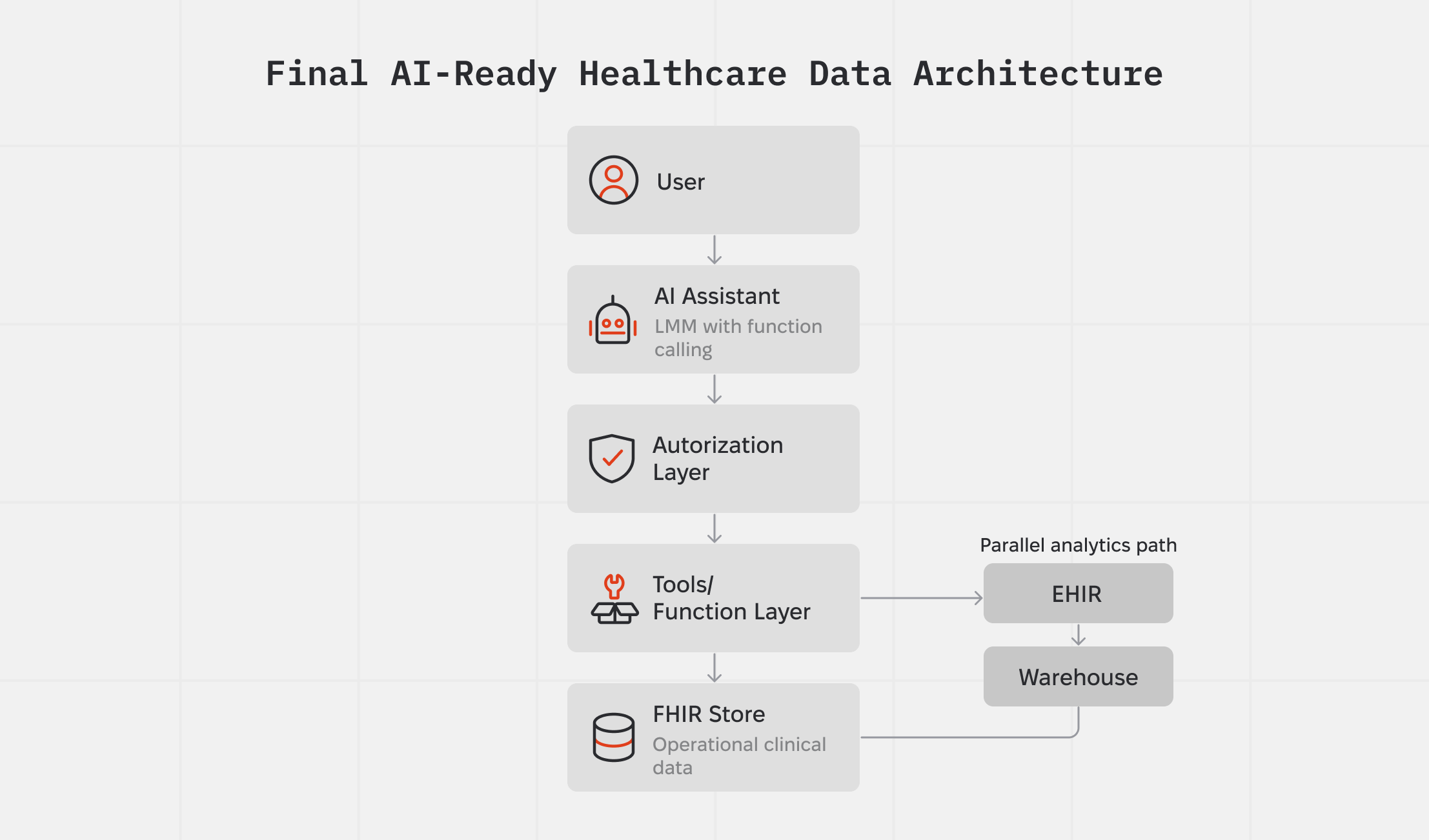
What this architecture enables:
✔ AI assistants that can act on behalf of users, with their exact permissions
✔ Strict HIPAA/GDPR compliance driven by technical enforcement
✔ Safe, contextual retrieval of clinical data
✔ Explainable, traceable AI behavior
✔ Ability to scale by simply adding new functions without redesigning the system
✔ No need for custom models, only LLMs + structure
Bottom Line: What Makes a Healthcare Platform AI-ready?
AI readiness in healthcare has far less to do with picking the “right” model and almost everything to do with the shape of your data and systems.
If your architecture is built on structure, permissions, auditability, and controlled data access, then you can confidently plug LLMs into clinical workflows. If it’s not, no model will be safe or trustworthy enough.
At MEV, we’ve spent almost 20 years shipping software in regulated environments, including healthcare. We’ve lived through HIPAA, GDPR, SOC 2, ISO 27001, shifting AI guidance, and our take is simple: regulation isn’t the bottleneck, sloppy architecture is.
If you're planning an AI initiative in healthcare, our AI engineering for healthcare team can help with the part most vendors gloss over: getting your data and architecture AI-ready. Tell us what you want to build, and we’ll give you a straight answer on what it will take in time, scope, and budget.
We wrote this page for engineering and product leads who need to know what changes in a data platform before a model can reach patient records, and which federal deadlines apply to that work.
FAQ
What is healthcare data architecture?
Healthcare data architecture is how data is collected, stored, transformed, and accessed across a health organization. Modern AI-ready architectures run on four layers: a FHIR (Fast Healthcare Interoperability Resources) operational store for day-to-day clinical workflows, a warehouse or lakehouse for analytics and ML, master data management (MDM) for identities and golden records, and an API and access layer for secure usage. Pipelines, monitoring, logging, and compliance controls sit around all four.
What is AI-ready healthcare data?
AI-ready healthcare data is standardized and labeled for safe use by models. Schemas and vocabularies are consistent, duplicates and conflicts are resolved, and identities for patients, providers, payers, and facilities are reconciled. Consent, purpose-of-use, and provenance travel with the data. Raw PHI (protected health information) stays restricted while downstream views expose only the fields a given task needs, so every AI output traces back to the record and trigger behind it.
How do I make healthcare data AI-ready?
Healthcare data becomes AI-ready when it is standardized and reachable through governed interfaces. Map your sources into a shared schema first, usually FHIR, then run MDM and data quality checks to resolve duplicates, conflicting codes, and missing fields. Build a de-identified analytics path into a warehouse or lakehouse, label data with consent and provenance, and expose it through a controlled tools layer. Attach LLMs to that curated layer only.
What rules and deadlines shape AI-ready healthcare data architecture in 2026?
Three matter most for architecture decisions. The CMS Interoperability Framework asked participating networks to serve data through FHIR APIs aligned to US Core and USCDI v3 by July 4, 2026. CMS runs this as a voluntary pledge, and the first wave included 21 networks signing on as CMS Aligned Networks alongside seven EHR vendors. CMS-0057-F sets a compliance date of primarily January 1, 2027 for impacted payers to run four FHIR APIs, including Provider Access and Prior Authorization, with exact dates varying by payer type. Operational prior authorization rules took effect January 1, 2026, and payers published their first prior authorization metrics by March 31, 2026. OCR's proposed HIPAA Security Rule update, published January 6, 2025, would make multi-factor authentication and encryption of ePHI mandatory. The rule remains a proposal, and OMB's 2026 Unified Agenda now projects final action in July 2027, so the current Security Rule governs today.
How should I design healthcare data platform architecture for AI use cases?
Design backward from the use case. Map operational systems into a standardized schema first, usually FHIR, then add only what the use case needs: a warehouse or lakehouse path for de-identified analysis and evaluation datasets, MDM for consistent identities, and an access layer that keeps application traffic separate from AI traffic, each with its own controls and SLOs.
What is an AI-ready healthcare API?
An AI-ready healthcare API is the access layer above your FHIR store, MDM, and analytics systems, built for humans and AI agents to use safely and predictably. You define task-focused tools like fetch_medication_list or check_coverage_status, each executing underlying REST, FHIR, or GraphQL calls with strict scopes and masking rules, and you keep raw endpoints out of reach. Stable schemas and versioning keep those tools working across releases, while fine-grained permissions at patient, resource, and field level plus full request logging keep PHI access controlled.
What is patient data architecture?
Patient data architecture is how you structure and govern the longitudinal record for each patient. A stable identity from MDM links encounters, labs, meds, procedures, imaging, claims, and device data, and a FHIR-based model represents those elements predictably. De-identified views serve research while identifiable records stay behind strong controls, so AI can understand patient history without compromising privacy.
What are the basics of setting up HIPAA-ready cloud architecture for a small AI triage service?
Start with a small, hardened footprint. Use a HIPAA-eligible cloud and sign a BAA, then put PHI in private subnets inside a VPC or VNet with strict security groups and VPN or direct connectivity. Store clinical data in a FHIR-compatible operational store encrypted at rest and in transit, front it with an API gateway handling TLS termination, OAuth2/OIDC, rate limiting, and audit logging, and let the model reach data only through a narrow tools layer.
How do I design a privacy-safe data architecture across payers, providers, and manufacturers?
Start with shared semantics and strict governance. Use FHIR as the backbone for clinical data and define clear schemas for claims, eligibility, authorization, and finance. A central or federated MDM layer links identities while tracking source-of-truth. Default to de-identified or tokenized datasets for anything crossing organizational lines, bounded by consent and contract, and route all access through an audited API layer that enforces org-specific roles and purpose-of-use.
What is the best way to build AI-ready datasets from insurance operations?
Build them from normalized operational events linked to a single identity layer. Normalize claims, prior auth, eligibility, denials, appeals, and contact-center interactions into clear schemas, mapping to FHIR resources like Coverage, Claim, and ExplanationOfBenefit where it helps. Link everything to patients, providers, and plans through MDM, then build de-identified analytic tables with stable keys and business dimensions, with quality checks automated in the pipeline.